Theme
Black hair and identity
Hair as identity, family, artistry and enterprise — and as a target of racialised rules — told without reducing it to struggle alone.
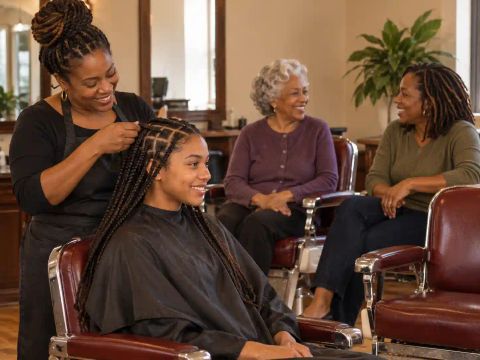
The Smithsonian’s National Museum of African American History and Culture describes hair care and styling as ways of defining Black identities, and notes that some braided styles have conveyed background, status and life events.[1] The Smithsonian’s Center for Folklife and Cultural Heritage writes about hair as part of revitalised Black identity.[2] Evidence status: Verified This hub gathers our work on that history.
Enterprise, training and the salon
Black beauty culture created businesses, training networks and skilled work. Annie Turnbo Malone and Madam C. J. Walker built influential companies in the United States; Walker worked as a Poro sales agent before founding her own.[5] Smithsonian research connects beauty salons to economic independence and to the Black freedom struggle.[3] Evidence status: Verified
Pride, politics — and more
In the 1960s and 1970s, natural hair and the Afro became powerful expressions of pride and politics in the United States.[4] Evidence status: Interpretation But we try to record resistance, adaptation and pleasure, and not to reduce all Black hair to trauma or politics. Hair is also craft, fashion, family time and fun.
Black British hair history
Evidence status: Research Britain’s own history — early Black-owned hair businesses, how Caribbean, African and South Asian migrants sourced products and skills after 1945, and salons as community spaces — is a priority we have only begun. We will research it through the Black Cultural Archives and local salon histories, and will not assume that American experience transferred unchanged.
Rules and discrimination
Standards of hair presented as “professional”, “tidy” or “civilised” have been used to penalise Black children and adults. See Hair and school for current guidance in Britain.
How we write about this
- We use culture-specific names for styles, with attribution.
- We compare the praise, punishment and profit that followed when similar styles were worn by people of different races.
- We ask for community review before publishing, and credit it on each page.
Explore this theme
-
Object · Prehistoric to present
The comb
The most ordinary hair tool, and one of the most revealing — from ancient carved combs to celluloid dressing-table sets, wide-toothed picks and heated pressing combs.
-
1869 or 1877 – 1957
Annie Turnbo Malone
Founder of the Poro hair-care company and its training network — a pioneer of Black women’s enterprise often overshadowed in popular memory.
-
c. 1920–2003
Christina M. Jenkins
Ohio cosmetologist who patented a method of weaving added hair onto a client's own hair in 1952, called it the Hair-Weev, and spent four decades teaching it — a founder of modern sewn-in weaving, not the inventor of added hair.
-
1930–2014
J. D. ’Okhai Ojeikere
Nigerian photographer whose Hairstyles series, begun in 1968, is one of the richest visual records of women’s hair in any country — made in the years after independence from British rule, and now held in London as well as Paris and New York.
-
1938–2023
Kwame Brathwaite
Harlem photographer whose pictures of the Grandassa Models and the “Naturally” fashion shows made natural hair a visible ideal of beauty in the early 1960s, and whose images reached Black publications in Britain at the time.
-
1867–1919
Madam C. J. Walker
Sarah Breedlove built an influential hair-care company and training network — but she did not invent the hot comb.
-
1896–1994
Marjorie Stewart Joyner
Beautician, teacher and Walker company executive who patented a permanent-waving machine in 1928 and spent half a century training hairdressers — and organising them.
-
1912?–2008
Rose Meta Morgan
Harlem beautician and entrepreneur whose Rose Meta House of Beauty was described as the largest Black beauty salon in the world, and who helped found a Black-owned bank in Harlem.
-
Essay
Black British hair
From suitcases packed with hot combs to Tottenham hair businesses, Brixton salons, Alexandra Palace hair shows and the Halo Code — a history of hair in Black British communities since 1945, told as skill, trade, family time and pleasure as well as struggle.
-
Essay
From kitchen to salon
Most hair work has always been done unpaid, at home, by mothers, sisters, friends and women themselves. This essay follows that labour into the paid salon — a trade, a workplace, a women’s business and a meeting place — mainly in Britain and Ireland, with American and diasporic comparison.
-
Essay
How trends travel
From engraved coiffure plates to TikTok, each new medium changed how fast a hairstyle could be seen. This essay follows the channels (prints, photographs, film, fan magazines, trade journals, television and platforms) and asks what evidence could ever show that a famous head caused many others to follow.
-
Essay
Rules about hair
Prisons, poorhouses, hospitals, kitchens, factories, schools and the army have all written rules about women’s and girls’ hair. This essay compares what the rules said with how they were enforced, separates genuine task-specific safety from demands for a particular look, and asks whose natural hair was treated as the problem — mainly in Britain, from the 1840s to today.
-
Essay
Heat, electricity and chemistry
Taps, shampoo, tongs, dryers, perm machines, relaxers, synthetic dyes, plastics and fibres all changed what could be done with hair. This essay asks what each one cost in time, labour and money — and who could afford it — mainly in Britain, with American comparison.
-
Style · Dressed style
The Afro
Coily hair worn in its own texture and shaped into a rounded form — a powerful image of pride and politics, and also a style people wore for many other reasons.
-
Style · Braided, twisted or locked
Braids and plaits
One of the oldest ways of dressing hair — and not one style but many, from a school plait tied with a ribbon to cornrows, box braids and ancient braided wigs.
-
Style · Braided, twisted or locked
Locs
Rope-like strands formed as hair is allowed or encouraged to mat — worn across many cultures and faiths, and still penalised by some school and workplace rules.
-
Technique · Temporary setting
Marcel waving
A deep, regular wave made with heated irons — a salon skill that shaped late-Victorian, Edwardian and 1920s hair, and a staple of Black beauty culture.
-
Technique · Temporary setting
Pressing and straightening
Straightening curly and coily hair with a heated comb, and later with chemical relaxers and smoothing treatments — skilled work with a long, contested history.
-
1900–1918
Edwardian volume to wartime practicality
Pompadours built over pads and switches under wide hats; electrified salons, Marcel waving and the first permanent-wave machines; and the rise of Black women’s hair-care enterprise.
-
1930–1945
Waves, glamour and war
Softer waves and salon permanents; Black beauty culture as work and organising; wartime rolls, scarves and snoods — and the gap between propaganda and the factory floor.
-
1960–1969
Height, geometry and pride
Beehives and bouffants beside precision geometric cuts and long straight hair; the Afro and "Black is Beautiful"; backcombing, rollers, lacquer and wigs.
-
1970–1979
Shags, feathers and afros
Long centre partings, feathered and shag cuts, Afros and braids, and punk’s bleach and spikes — a decade in which no single look ruled, and none carried a single meaning.
-
1980–1989
Scale and finish
Big perms and blow-dries, asymmetry and crimping, gel and spikes; New Romantic and goth scenes; Jheri curls, braids and extensions — and the style magazines that recorded them.
-
1990–1999
Minimal and layered
Cropped and slicked, layered and blow-dried, braided and extended — a decade of session stylists, sitcom haircuts and hair shows, and of sharp arguments over who got credit for braids.
-
2010–2019
The platform era
Tutorials, feeds and influencers; natural-hair communities and the debates they carried; ombré, beach waves and braids; pupils in Britain who challenged school hair rules; and women who stopped dyeing and said so in public.
-
2020–2026
Pandemic and microtrends
A dated snapshot, not a verdict — salon closures and home haircuts, the Halo Code, and trends that now rise and fall at the speed of a feed.
-
1837–1900
Loops, nets and fringes
Six decades of changing shapes — smooth centre parts and side loops, netted chignons, false plaits and curled fringes — built with pins, pads and bought hair, some of it harvested from poorer women.
-
Theme
Hair and school
Plaits before the bell, rules about length and "extreme" styles, and whose natural hair has been treated as a problem — from written rules to how they were enforced.
Sources
- Smithsonian National Museum of African American History and Culture, “Strands of Inspiration: Exploring Black Identities through Hair”, Smithsonian Institution. Accessed 25 September 2026. What it shows: Hair care and styling as ways of defining Black identities; braided styles that conveyed background, status and life events.
- Kamryn Z. Bess, “It’s More Than “Just” Hair: Revitalization of Black Identity”, Folklife Magazine, Smithsonian Center for Folklife and Cultural Heritage, 6 November 2022. Accessed 12 November 2026. What it shows: Draws on interviews with stylists and family memories to argue that hair is central to Black identity and that restoring respect for natural texture is part of revitalising it; mentions school hair discrimination and the CROWN Act.
- Jay Driskell, “Making Waves: Beauty Salons and the Black Freedom Struggle”, Smithsonian Institution, 3 November 2016. Accessed 19 September 2026. What it shows: Museum interpretation connecting beauty salons to economic independence and civil-rights organising in the United States. Says Marjorie Stewart Joyner was a founding member of the National Council of Negro Women in 1935 and founded the United Beauty School Owners and Teachers Association in 1945; that Highlander Folk School ran workshops training beauticians in civil disobedience and voter registration; and that parlours “provided shelter for civil rights organizing”.
- Smithsonian National Museum of African American History and Culture, “Black is Beautiful: The Emergence of Black Culture and Identity in the 60s and 70s”, Smithsonian Institution. Accessed 25 September 2026. What it shows: The movement “affirmed natural hairstyles like the ‘Afro’” and inspired cultural pride; using an Afro pick customised with a black fist was a way to assert allegiance to the Black Power movement.
- Smithsonian National Museum of African American History and Culture, “Annie Malone and Madam C.J. Walker: Pioneers of the African American Beauty Industry”, Smithsonian Institution. Accessed 25 September 2026. What it shows: States that Malone pioneered the path Walker took and that Walker became a Poro agent. Its phrase “enrolled at Malone’s Poro College” is anachronistic — the college opened in 1918.
Further reading
- Ayana D. Byrd and Lori L. Tharps, Hair Story: Untangling the Roots of Black Hair in America, St. Martin’s Press, 2001. details to check
- Noliwe M. Rooks, Hair Raising: Beauty, Culture, and African American Women, Rutgers University Press, 1996. details to check
- Tiffany M. Gill, Beauty Shop Politics: African American Women’s Activism in the Beauty Industry, University of Illinois Press, 2010. details to check
- Emma Dabiri, Don’t Touch My Hair, Allen Lane, 2019. details to check An Irish-Nigerian writer on Black hair, history and culture.