
1980–1989
Scale and finish
Big perms and blow-dries, asymmetry and crimping, gel and spikes; New Romantic and goth scenes; Jheri curls, braids and extensions — and the style magazines that recorded them.
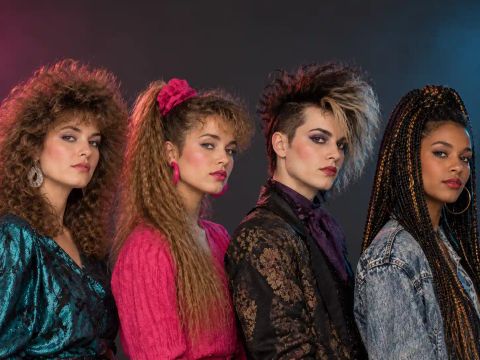
If one word describes 1980s hair in Britain it is more: more volume, more product, more colour, more asymmetry. But “80s hair” as a single look is a later cliché. The decade was made of local scenes, each with its own rules.
Clubs and scenes
The Blitz club ran on Tuesday nights at 4 Great Queen Street, Covent Garden, from 1979 to 1981. The London Museum describes the New Romantic style that grew there as “theatrical hair and makeup” with clothes that “challenged traditional ideas about gender”.[1] Evidence status: Verified In 1980 the King’s Road shop that had been Sex and Seditionaries reopened as Worlds End.[2]
Evidence status: Interpretation The New Romantic look matters to this history because it made elaborate hair and makeup part of a shared, cross-gender style. It also shows why we write about scenes, not decades: Blitz lasted barely two years, yet its images are now used to stand for a whole era.
Evidence status: Research Goth, hip-hop, club and other scenes in cities beyond London — and the women in them — are not yet documented here. We will look for local photography and fanzines.
Perms, blow-dries and crimping
Permanent waves returned on a large scale, alongside big blow-dries, crimping irons and new styling products such as mousse and gel. Evidence status: Research We have not yet dated these products’ arrival in British shops, or measured how common big perms were, for example through salon price lists and school photographs.
Black styles and markets
Evidence status: Research The 1980s saw Jheri curls, braids with extensions, asymmetric cuts and natural styles, with salons, music video and music magazines creating overlapping markets. We have not yet researched how this played out in Britain’s Black salons and hair shops, and will do so with community archives.
Industry
Evidence status: Research Franchise salon chains, professional product brands and vocational hairdressing courses all grew in the period. Their records are an important and under-used source that we have not yet examined.
Children and teenagers
Evidence status: Interpretation School photographs, mail-order catalogues and teen magazines can show how adult trends were simplified — or forbidden — for children. They are among the best sources for everyday hair in the 1980s, precisely because they were not trying to be fashionable.
Styles, techniques and people from this period
-
c. 1920–2003
Christina M. Jenkins
Ohio cosmetologist who patented a method of weaving added hair onto a client's own hair in 1952, called it the Hair-Weev, and spent four decades teaching it — a founder of modern sewn-in weaving, not the inventor of added hair.
-
Essay
Black British hair
From suitcases packed with hot combs to Tottenham hair businesses, Brixton salons, Alexandra Palace hair shows and the Halo Code — a history of hair in Black British communities since 1945, told as skill, trade, family time and pleasure as well as struggle.
-
Technique · Chemical texture change
Permanent waving
Changing the shape of hair until it grows out — from hours attached to a heated machine to a cold-wave kit on the kitchen table.
Sources
- London Museum, “Blitz: a revolutionary 1980s club night”. Accessed 25 September 2026. What it shows: Tuesday nights at 4 Great Queen Street, Covent Garden, 1979–81; New Romantic "theatrical hair and makeup" and clothes that "challenged traditional ideas about gender".
- London Museum, “Vivienne Westwood & Malcolm McLaren: King’s Road royalty”. Accessed 25 September 2026. What it shows: The shop at 430 King’s Road — Let It Rock (1971), Sex (1974), Seditionaries (1976), Worlds End (1980) — and its staff, including Jordan (Pamela Rooke), shown with a beehive hairstyle outside Sex.
Further reading
- Caroline Cox, Good Hair Days: A History of British Hairstyling, Quartet Books, 1999. details to check A general history of British hairdressing and styles.
- Ayana D. Byrd and Lori L. Tharps, Hair Story: Untangling the Roots of Black Hair in America, St. Martin’s Press, 2001. details to check