Technique
Permanent waving
Changing the shape of hair until it grows out — from hours attached to a heated machine to a cold-wave kit on the kitchen table.
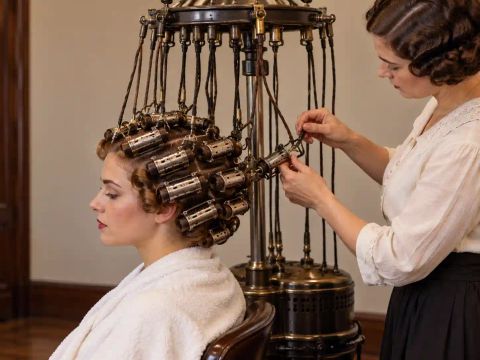
A permanent waveA process that changes the shape of the hair until it grows out, by chemically breaking and re-forming bonds in the hair. Early machine methods used heat as well as chemicals; “cold waves” did not. changes the shape of the hair until it grows out. Unlike a set or a Marcel wave, it survives washing, because it alters the hair’s internal structure rather than just holding a shape while dry. We describe this history in general terms only; it is not chemical advice.
Machine waves
Early permanent waves combined chemicals with heat. A 1926 Library of Congress photograph shows Norma Smallwood, that year’s Miss America, seated with her hair attached to electric permanent-wave equipment.[2] Evidence status: Verified
The German-born hairdresser Karl Nessler, who traded in London as C. Nestle & Co., filed British patents in February 1909, as Charles Nessler, for “a new or improved process of waving natural hair on the head” and for the apparatus to do it: hair wound on a curler, covered with moist flannel and placed in a tube of lotion that was heated from outside.[1] Evidence status: Verified Evidence status: Research Accounts date his first London demonstrations to 1905 or 1906; this still needs checking against contemporary reports.
Cold waves and home kits
Later methods dropped the heating machine and used lotions alone: the cold waveA permanent wave made with chemical lotions rather than heating equipment. Developed from the late 1930s, it made cheap home permanent kits common from the mid-to-late 1940s; heated home outfits had been sold earlier.. Cold waves made the home kit cheap and common: the Smithsonian dates home permanent-wave kits to the late 1940s,[3] Evidence status: Verified and its collection includes a kit made for children.[4] Heated home outfits had been sold earlier; see the home permanent kit.
Age and life stage
Evidence status: Interpretation Perms cross the whole of life in this history: children’s kits, teenagers’ first perms, the weekly routine of women whose sets were built on a perm, and the tightly curled “perm and set” that became associated — often unkindly — with older women. We record these as choices and routines, not as jokes.
Revivals
Evidence status: Research Large, curly perms were a defining look of the 1980s, and looser “modern perms” have returned since. How far these revivals reproduced the technique rather than only the look still needs checking.
Safety
This site is historical and educational, not chemical or hairdressing advice. Perm lotions are strong chemicals; follow current professional guidance. See Safety and health.
Tools and styles
-
Object · 1920s onwards; cold-wave kits from the 1940s
The home permanent kit
A box of lotions, rods and papers that brought the permanent wave out of the salon and into the kitchen — and, in some kits, onto children’s heads.
-
Object · 1880s to present in British collections
The hair dryer
From a stoneware bottle of boiling water to the row of humming salon hoods — how drying, the slowest part of every set, was turned into a machine.
Sources
- Charles Nessler, “A New or Improved Process of Waving Natural Hair on the Head (GB190902931A); Improvements in Apparatus for use in Waving Natural Hair on the Head (GB190920597A)”, UK Patent Office, applied 6 February 1909; published 3 February 1910. Accessed 25 September 2026. What it shows: British patents for Nessler’s chemical-and-heat permanent-waving process and apparatus.
- Library of Congress, Prints and Photographs Division, ““Miss America receives a permanent wave””, photograph, 14 October 1926. Accessed 25 September 2026. What it shows: Photograph of Norma Smallwood, Miss America 1926, seated with her hair attached to electric permanent-wave equipment.
- Smithsonian National Museum of American History, “Hair Care”, Smithsonian Institution. Accessed 25 September 2026. What it shows: Object group of tools, products and packaging. States that home permanent-wave kits were introduced in the late 1940s.
- Smithsonian National Museum of American History, “Tonette Children’s Home Permanent”, Smithsonian Institution. Accessed 25 September 2026. What it shows: Collection object 1984.0351.320, made by the Toni Company (Reid Drugstore collection, gift of Blanche E. Reid); undated. Evidence that chemical waving was sold for use on children; not evidence of how often it was used.
Further reading
- Caroline Cox, Good Hair Days: A History of British Hairstyling, Quartet Books, 1999. details to check A general history of British hairdressing and styles.
- Kathy Peiss, Hope in a Jar: The Making of America’s Beauty Culture, Metropolitan Books, 1998. details to check