Object
The home permanent kit
A box of lotions, rods and papers that brought the permanent wave out of the salon and into the kitchen — and, in some kits, onto children’s heads.
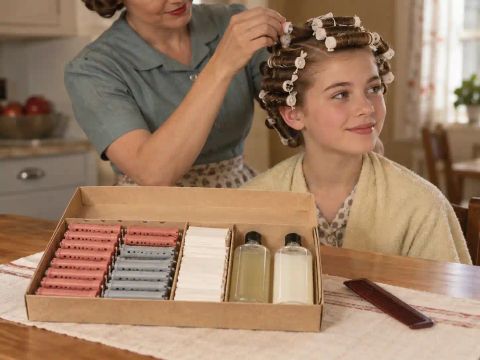
Until the 1940s, a permanent wave usually meant a salon visit — and for most of that time a heated machine. Home versions came earlier than is often said. In 1920 the Nestle company advertised a “Nestle Home Outfit” for permanent waving in Photoplay, sold by post,[4] and The Henry Ford holds a “Lady Carole” home permanent wave set of about 1940, sold by Montgomery Ward and marked “MACHINELESS OIL METHODS - Self Applied”.[5] Evidence status: Verified
What changed in the 1940s was the cheap, lotion-only cold-wave kit. The Smithsonian’s National Museum of American History dates home permanent-wave kits to the late 1940s,[1] Evidence status: Verified though its own collection includes a cold-wave home kit catalogued as about 1945.[3] Evidence status: Research Exactly when the first cold-wave home kits went on sale still needs checking against dated advertising.
How it worked, in general terms
Home kits used a cold waveA permanent wave made with chemical lotions rather than heating equipment. Developed from the late 1930s, it made cheap home permanent kits common from the mid-to-late 1940s; heated home outfits had been sold earlier.: lotions instead of a heated machine. This page describes historical products and does not give instructions. See the safety section below.
Made for children
Among the Smithsonian’s objects is a Tonette Children’s Home Permanent, made by the Toni Company; the museum gives no date for it.[2] Evidence status: Verified It also holds a children’s home permanent by Richard Hudnut. These objects show that chemical waving was marketed for use on children. Evidence status: Research They do not tell us how often children’s kits were used, or at what ages; that still needs checking against advertising, sales figures and memories.
Evidence status: Interpretation Children’s kits are evidence of how adults — usually mothers — shaped girls’ appearance, and of the pressure on families to produce a fashionable, photographable child. Today this site does not demonstrate chemical processes on children, and describes such products only as history.
Money, time and the salon
Evidence status: Interpretation Whatever its price, a home kit moved the labour of perming from the salon into the home, where it was usually done by women for women. The same shift — from the paid salon to unpaid help from family and friends — recurs throughout hair history.
Evidence status: Research When home kits reached British shops, which brands were sold, and what they cost relative to a salon perm, still need checking.
Safety
This site is historical and educational, not chemical or hairdressing advice. Perm lotions are strong chemicals: anyone considering a chemical treatment today should follow current professional guidance, not historical practice. See Safety and health.
Object story
- What is it made of, and how does it work?
- A cold-wave kit contained a waving lotion that broke some of the disulphide bonds inside the hair while it was wound on rods, and a neutraliser (an oxidising agent) that re-formed them in the new shape.
- Who made and sold it?
- Not yet researched.
- Who used it — at home, in the salon, at work?
- Women at home, often helped by a relative or friend — and parents who used children’s kits on their daughters.
- What signs of use should we look for?
- Not yet researched.
- Where can dated examples be seen?
- The Smithsonian’s hair-care collections include home permanents by several brands, including a children’s kit.
Used for
-
Technique · Chemical texture change
Permanent waving
Changing the shape of hair until it grows out — from hours attached to a heated machine to a cold-wave kit on the kitchen table.
Sources
- Smithsonian National Museum of American History, “Hair Care”, Smithsonian Institution. Accessed 25 September 2026. What it shows: Object group of tools, products and packaging. States that home permanent-wave kits were introduced in the late 1940s.
- Smithsonian National Museum of American History, “Tonette Children’s Home Permanent”, Smithsonian Institution. Accessed 25 September 2026. What it shows: Collection object 1984.0351.320, made by the Toni Company (Reid Drugstore collection, gift of Blanche E. Reid); undated. Evidence that chemical waving was sold for use on children; not evidence of how often it was used.
- Smithsonian National Museum of American History, “Charm-Kurl Supreme Cold Wave Home Permanent Kit (2010.0213.022)”, catalogued as ca. 1945. Accessed 12 November 2026. What it shows: A cold-wave home permanent kit by Fraser Hair Fashions, catalogued as about 1945.
- Nestle Co. (advertisement), “Nestle Home Outfit for permanent waving”, Photoplay, July–December 1920, Photoplay Magazine Publishing Company, Chicago, 1920. Accessed 12 November 2026. What it shows: Magazine advertisement, read through the Media History Digital Library, offering the “Nestle Home Outfit” for permanent waving by post, with a refund if returned within seven days.
- The Henry Ford, ““Lady Carole” Home Permanent Wave Set, circa 1940”, The Henry Ford, object ID 2024.166.48, catalogued as circa 1940. Accessed 12 November 2026. What it shows: Home permanent set made by Halgar Incorporated of Chicago and sold by Montgomery Ward & Co.; marked “MACHINELESS OIL METHODS - Self Applied” and “24 HEAT UNITS AND SOLUTION” — a heated home kit that needed no salon machine.
Further reading
- Kathy Peiss, Hope in a Jar: The Making of America’s Beauty Culture, Metropolitan Books, 1998. details to check
- Caroline Cox, Good Hair Days: A History of British Hairstyling, Quartet Books, 1999. details to check A general history of British hairdressing and styles.