Object
The hair dryer
From a stoneware bottle of boiling water to the row of humming salon hoods — how drying, the slowest part of every set, was turned into a machine.
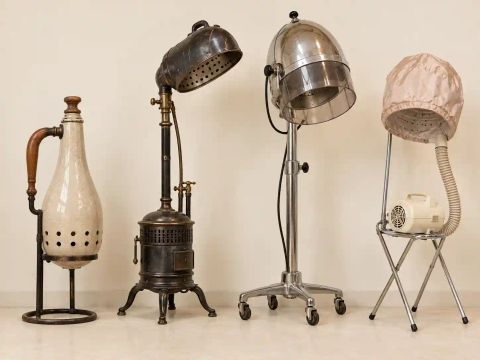
Every temporary set depends on drying. Before machines, that meant time — hours by a fire, in the sun, or overnight. The history of the hair dryer is the history of turning that time into a service that could be bought, scheduled and speeded up.
A dated British sequence
The Science Museum Group holds a run of dated dryers, mostly British, that shows the technology changing:[5] Evidence status: Verified
- 1880–1900: the stoneware “Thermicon”, made by Hincks & Co. of London, was filled with boiling water and brushed through the hair; its makers claimed it could dry hair “in a few minutes”. The museum notes that from the 1920s such dryers were gradually replaced by electrical devices.[1]
- c. 1920: a pedestal dryer heated by gas.[2]
- c. 1938: the “Airlux” salon electric dryer, catalogued as 1,400 × 400 × 680 millimetres and 33 kilograms, made by Osborne, Garrett & Co. of London.[3]
- 1958: a Pifco dryer with its own stand and hood.[4]
Evidence status: Research Surviving objects date a technology’s existence, not its spread. When hood dryers became ordinary in British high-street salons, and when home hoods became common, still needs checking against trade journals, catalogues, price lists and memories — and against the spread of mains electricity, which varied greatly by region and class.
The salon as a social space
Evidence status: Interpretation Sitting under a dryer created a pause: time to read magazines, talk or simply wait. Salon histories describe these spaces as places of community and conversation — for Black women in the United States, even of organising.[6] (See Black hair and identity.)
Time, work and age
Evidence status: Interpretation The hood made the weekly roller set possible on a working woman’s lunch hour or a Saturday morning, and it kept the weekly salon visit central to many older women’s routines long after younger clients had moved to hand-held blow-drying.
Object story
- What is it made of, and how does it work?
- Every version solves the same problem — getting warm, moving air (or heat) to damp hair without scorching the scalp. Early devices used stored heat; later ones gas or electric elements, with a fan and, for sets, a hood surrounding the head.
- Who made and sold it?
- British makers in the Science Museum Group collection include Hincks & Co. (stoneware, 1880–1900), Osborne, Garrett & Co. (salon, c. 1938), Pifco (1958) and Morphy Richards (c. 1960–1974).
- Who used it — at home, in the salon, at work?
- Salon clients waiting for a set to dry; later, women at home with hand-held dryers and portable hoods.
- What signs of use should we look for?
- Scorch marks, replaced flexes and plugs, and repairs to hoods can show long use — and changing electrical safety standards.
- Where can dated examples be seen?
- The Science Museum Group object listing for “hair dryer” gives dates, makers and object numbers for each example cited here.
Used for
-
Technique · Temporary setting
Roller setting
Winding damp hair on rollers and drying it in place — the engine of the weekly "shampoo and set" and of mid-century volume.
-
Technique · Temporary setting
Finger waving
Shaping wet hair with fingers and a comb into rippling S-shaped ridges — the signature set of the late 1920s and 1930s, and a test of skill.
Sources
- Science Museum Group, “Stoneware hair dryer, ‘Thermicon’, London, England, 1880–1900 (A650887/2)”. Accessed 25 September 2026. What it shows: Made by Hincks & Co., London. Filled with boiling water and brushed through the hair; from the 1920s such dryers were gradually replaced by electrical devices.
- Science Museum Group, “Pedestal gas-heated hair dryer, c. 1920 (1976-25)”. Accessed 25 September 2026.
- Science Museum Group, “Salon electric hair dryer, ‘Airlux’, c. 1938 (1999-1142)”. Accessed 25 September 2026. What it shows: A salon dryer made by Osborne, Garrett & Co. Ltd, London; catalogued as overall 1400 × 400 × 680 mm and 33 kg.
- Science Museum Group, “Pifco hair dryer with stand and hood, 1958 (1995-316)”. Accessed 25 September 2026.
- Science Museum Group, “Hair dryer (object type listing)”. Accessed 25 September 2026. What it shows: Dated dryers, mostly British, from stoneware (1880–1900) to electric hand, hood and salon models (1920–1999).
- Jay Driskell, “Making Waves: Beauty Salons and the Black Freedom Struggle”, Smithsonian Institution, 3 November 2016. Accessed 19 September 2026. What it shows: Museum interpretation connecting beauty salons to economic independence and civil-rights organising in the United States. Says Marjorie Stewart Joyner was a founding member of the National Council of Negro Women in 1935 and founded the United Beauty School Owners and Teachers Association in 1945; that Highlander Folk School ran workshops training beauticians in civil disobedience and voter registration; and that parlours “provided shelter for civil rights organizing”.
Further reading
- Caroline Cox, Good Hair Days: A History of British Hairstyling, Quartet Books, 1999. details to check A general history of British hairdressing and styles.