
Technique
Roller setting
Winding damp hair on rollers and drying it in place — the engine of the weekly "shampoo and set" and of mid-century volume.
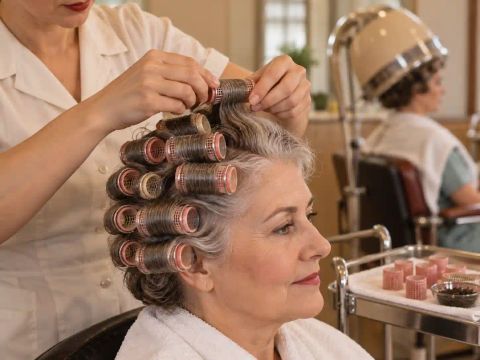
A roller setHair wound on rollers while damp and dried in place — at a salon often under a hood dryer — then brushed and dressed. A weekly routine for many women in the mid-twentieth century. works on the same principle as every temporary set: damp hair keeps the shape in which it dries. Rollers simply make that shape larger, faster and more even than rags or pin curls.
The sequence, summarised from historical practice
- The hair was washed and towel-dried, and setting lotion applied.
- It was divided into sections, and each section combed smooth and wound around a roller.
- Rollers were secured with pins or clips, their direction and size planned for the finished shape.
- The set was dried — under a hood dryer in the salon, or at home, sometimes overnight.
- Rollers were removed and the hair brushed, backcombed or dressed into its final form.
Where it fits in the history
Earlier curling relied on rags, papers, pins and heated tongs. Evidence status: Research When rollers displaced pin curls in British salons still needs checking against trade journals.
After the Second World War, the weekly salon set and the home set became routine for many women. The Smithsonian’s hair-care collections note that home permanent-wave kits appeared in the late 1940s.[1] Evidence status: Verified Rollers, lotion and hood dryers underpinned the volume of 1950s sets and 1960s bouffants.
The weekly set
Evidence status: Interpretation For many women — and especially for older women, into the twenty-first century — the weekly shampoo and set was more than a hairstyle. It was a fixed appointment, a social visit, a mark of respectability and a way of managing hair between washes. Its meaning deserves to be recorded, not mocked.
Evidence status: Research What a weekly set cost relative to wages in each decade is not yet known to us; price lists will be needed to check.
Revivals
Evidence status: Current In the 2020s, “heatless” curling methods circulated widely on social platforms. Many of them rework older principles — rags, wraps and overnight sets — under new names.
Tools and styles
-
Object · 1880s to present in British collections
The hair dryer
From a stoneware bottle of boiling water to the row of humming salon hoods — how drying, the slowest part of every set, was turned into a machine.
-
Object · Prehistoric to present
The comb
The most ordinary hair tool, and one of the most revealing — from ancient carved combs to celluloid dressing-table sets, wide-toothed picks and heated pressing combs.
-
Style · Dressed style
The beehive
A tall, rounded dome of backcombed hair — one of the few styles with a named, dated creator, and a lesson in how a magazine commission could become a decade’s silhouette.
-
Style · Dressed style
Victory rolls
Hair rolled high at the front and pinned — the style most people now picture for the 1940s, and one of the most revived.
Sources
- Smithsonian National Museum of American History, “Hair Care”, Smithsonian Institution. Accessed 25 September 2026. What it shows: Object group of tools, products and packaging. States that home permanent-wave kits were introduced in the late 1940s.
Further reading
- Caroline Cox, Good Hair Days: A History of British Hairstyling, Quartet Books, 1999. details to check A general history of British hairdressing and styles.