Object
The comb
The most ordinary hair tool, and one of the most revealing — from ancient carved combs to celluloid dressing-table sets, wide-toothed picks and heated pressing combs.
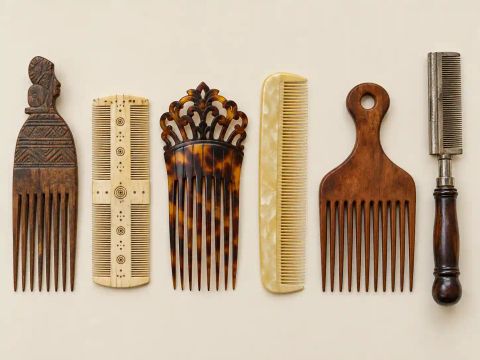
The comb is so ordinary that it is easy to overlook. But a comb’s material, the spacing of its teeth and its decoration can tell us who used it, for what, and what it cost.
A family of tools
- Detangling and dressing combs: wide teeth at one end, fine at the other.
- Fine-toothed combs: used, among other things, to remove lice — a reminder that hair care was also health care, especially for children.
- Ornamental combs: set into dressed hair to hold and decorate it. Evidence status: Research The dating of back combs and decorative combs in Regency and Victorian Britain still needs checking against dated museum examples.
- Wide-toothed combs and picks: designed for curly and coily hair and for shaping styles such as the Afro.
- Pressing combs: metal combs heated and drawn through the hair to straighten it temporarily (see the pressing combA metal comb heated and drawn through hair to straighten it temporarily. Madam C. J. Walker did not invent it, despite a recurring claim.).
Materials and price
Evidence status: Research New materials — celluloid in the late nineteenth century, then other plastics — probably made combs cheaper and more widely owned. This is a likely story, not yet a documented one: it needs checking against dated catalogues and price lists. Museum collections of hair-care tools and products, such as the Smithsonian’s, can help date types.[2]
Why ordinary combs matter
Evidence status: Interpretation Museums tend to keep the carved, the inlaid and the gilded. We want representative tools too: the chipped comb in a school bag, the salon comb soaking in disinfectant, the family comb shared between sisters.
Object story
- What is it made of, and how does it work?
- A spine with teeth. The spacing of the teeth decides the job — detangling, smoothing, parting, removing lice, lifting or holding.
- Who made and sold it?
- Not yet researched.
- Who used it — at home, in the salon, at work?
- Almost everyone. Combs were used on children by carers, shared in households, and used professionally in salons.
- What signs of use should we look for?
- Broken or worn teeth, repairs, owners’ marks, and residues of oils or pomades.
- Where can dated examples be seen?
- Not yet researched.
Used for
-
Technique · Temporary setting
Finger waving
Shaping wet hair with fingers and a comb into rippling S-shaped ridges — the signature set of the late 1920s and 1930s, and a test of skill.
-
Technique · Temporary setting
Roller setting
Winding damp hair on rollers and drying it in place — the engine of the weekly "shampoo and set" and of mid-century volume.
Sources
- Moriah James, “Sizzle”, Smithsonian Institution, 10 January 2019. Accessed 25 September 2026. What it shows: On the pressing (hot) comb. Corrects the misconception that Madam C. J. Walker invented it; she and her “hair culturists” regularly used it, and her textbook taught a straightening process, though she said her products were for healthy hair. Also lists Poro’s “Marcel Waving Iron” and “Marcel Comb”, and combs heated on the kitchen stove.
- Smithsonian National Museum of American History, “Hair Care”, Smithsonian Institution. Accessed 25 September 2026. What it shows: Object group of tools, products and packaging. States that home permanent-wave kits were introduced in the late 1940s.