
Style
The Afro
Coily hair worn in its own texture and shaped into a rounded form — a powerful image of pride and politics, and also a style people wore for many other reasons.
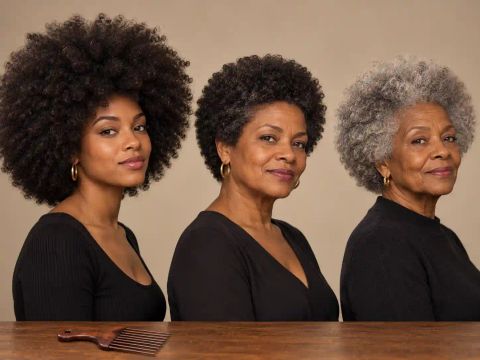
An Afro is coily or tightly curled hair worn in its own texture and combed or picked out into a rounded shape. It is shaped by the hair itself, and by a wide-toothed comb or pick — tools with their own history.
Form and construction
The Afro is not cut to a template: its size and outline depend on the wearer’s hair, how it is washed, detangled and moisturised, and how it is picked out and shaped. It may be trimmed to hold a round, oval or sculpted outline, or worn loose and varied.
Documented wearers
The Smithsonian’s National Museum of African American History and Culture describes how the “Black is Beautiful” movement of the 1960s and 1970s affirmed natural hairstyles like the Afro and inspired cultural pride; using an Afro pick with a black-fist handle was a way to assert allegiance to the Black Power movement.[1] Evidence status: Verified
The photographer Kwame Brathwaite’s images of the Grandassa Models are central to that visual history; see Kwame Brathwaite, where the work is described and linked rather than reproduced.
In Britain, Evidence status: Research the Afro’s history among Caribbean, African and Black British communities in the 1960s and 1970s is a priority we have not yet researched. We will not assume that American meanings transferred unchanged; the evidence to check is in the Black Cultural Archives and community photography.
Age and life stage
- Children and school: Evidence status: Current The Equality and Human Rights Commission’s guidance for schools in Britain says that banning hairstyles associated with particular racial groups, without exceptions, is likely to be unlawful — naming natural Afro hairstyles among them — and notes that hair discrimination falls disproportionately on pupils with Afro-textured hair.[4][5] See Hair and school.
- Teenagers and young adults: in the 1960s and 1970s, the age group most visible in images of the Afro as a political style.
- Midlife and older age: Evidence status: Research how older women wore, adapted or returned to natural hair has not yet been documented here, and still needs checking.
Revivals and continuity
In the 2010s, online communities shared knowledge about curls, coils, locs and styling, as part of what is often called the natural-hair movement. We treat this not as a simple “revival” of the 1970s but as a new chapter, involving commerce, community and debates about texture-classification systems.
Care and safety
How was it made?
-
Object · Prehistoric to present
The comb
The most ordinary hair tool, and one of the most revealing — from ancient carved combs to celluloid dressing-table sets, wide-toothed picks and heated pressing combs.
Sources
- Smithsonian National Museum of African American History and Culture, “Black is Beautiful: The Emergence of Black Culture and Identity in the 60s and 70s”, Smithsonian Institution. Accessed 25 September 2026. What it shows: The movement “affirmed natural hairstyles like the ‘Afro’” and inspired cultural pride; using an Afro pick customised with a black fist was a way to assert allegiance to the Black Power movement.
- Smithsonian National Museum of African American History and Culture, “Strands of Inspiration: Exploring Black Identities through Hair”, Smithsonian Institution. Accessed 25 September 2026. What it shows: Hair care and styling as ways of defining Black identities; braided styles that conveyed background, status and life events.
- Kamryn Z. Bess, “It’s More Than “Just” Hair: Revitalization of Black Identity”, Folklife Magazine, Smithsonian Center for Folklife and Cultural Heritage, 6 November 2022. Accessed 12 November 2026. What it shows: Draws on interviews with stylists and family memories to argue that hair is central to Black identity and that restoring respect for natural texture is part of revitalising it; mentions school hair discrimination and the CROWN Act.
- Equality and Human Rights Commission, “Preventing hair discrimination in schools”, published 27 October 2022. Accessed 25 September 2026. What it shows: Current guidance for schools in Britain. A policy banning hairstyles associated with particular racial or religious groups, without exceptions, is likely to be unlawful indirect discrimination; names Afro hairstyles, braids, locks, twists, cornrows, plaits, skin fades, head coverings and head wraps, and disability-related needs such as wigs during cancer treatment.
- Equality and Human Rights Commission, “Britain’s equality watchdog takes action to prevent hair discrimination in schools”, 27 October 2022. Accessed 25 September 2026. What it shows: Announcement of the 2022 resources, which note that hair discrimination disproportionately affects pupils with Afro-textured hair or hairstyles.
- British Association of Dermatologists, “Caring for Afro-textured hair”, produced July 2023. Accessed 12 November 2026. What it shows: Patient information leaflet. Says a relaxer should never be left on long enough to burn the scalp, that burns can lead to permanent hair loss, that relaxers on skin can cause contact dermatitis, and that there have been reports linking relaxer use with a higher risk of central centrifugal cicatricial alopecia (CCCA), a scarring hair loss. The leaflet’s own next review date (July 2026) has passed.
Further reading
- Ayana D. Byrd and Lori L. Tharps, Hair Story: Untangling the Roots of Black Hair in America, St. Martin’s Press, 2001. details to check
- Emma Dabiri, Don’t Touch My Hair, Allen Lane, 2019. details to check An Irish-Nigerian writer on Black hair, history and culture.
- Noliwe M. Rooks, Hair Raising: Beauty, Culture, and African American Women, Rutgers University Press, 1996. details to check