Theme
Hair and school
Plaits before the bell, rules about length and "extreme" styles, and whose natural hair has been treated as a problem — from written rules to how they were enforced.
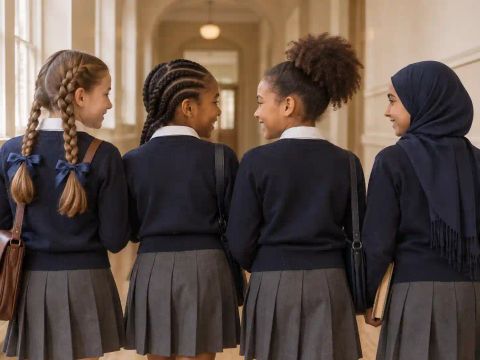
For many girls, school is the first place where someone outside the family has rules about their hair. This hub brings together the history of those rules and the present-day guidance that governs them in Britain.
Rules and enforcement
Written rules are only half the story. We compare what rules said with how they were enforced, and ask whose hair was classified as “extreme”, “distracting”, “unprofessional” or “unsafe”. Genuine task-specific safety needs — tying long hair back in a laboratory, for example — are real, but they are not a blanket justification for rules that are really about appearance.
Evidence status: Research School rules on hair length, tying back and lice inspection from the nineteenth and twentieth centuries still need to be gathered from school records. Rules overrepresent authority, and children’s own views survive unevenly, so we read them with that imbalance in mind.
Current guidance in Britain
Evidence status: Current The Equality and Human Rights Commission’s guidance for schools says that a policy banning hairstyles associated with particular racial or religious groups, without the possibility of exceptions, is likely to be unlawful indirect discrimination. Its examples include natural Afro hairstyles, braids, locks, twists, cornrows, plaits, head coverings and African-heritage head wraps.[1]
Evidence status: Current The guidance also covers disability: schools may need to make exceptions — for example for a pupil having cancer treatment who wears a wig, scarf or hat. Its accompanying decision-making tool recommends consulting pupils, parents, carers and staff when writing a policy.[1]
Evidence status: Current The Commission published these resources in 2022, noting that hair discrimination disproportionately affects pupils with Afro-textured hair or hairstyles.[2]
This is a summary for historical context, not legal advice. Check the Commission’s current guidance before relying on it.
Faith, disability and difference
Rules about hair also meet religious practice — covering, or not cutting, hair — and disability, including hair loss and the wearing of wigs. We will commission faith-literate and disability-led writing for these sections rather than generalising.
Questions we are researching
- At what ages did girls gain practical control over their own hair in different periods and households?
- How did school rules vary between different kinds of school, and between Britain and Ireland?
- Which colonial school rules explicitly governed hair?
- How are school-photograph conventions useful as evidence, and where do they mislead?
Explore this theme
-
Essay
Age and hair
Who decides how a girl’s hair is worn, when that power passes to her, and what happens to it again in old age — a history told across a lifetime rather than a decade.
-
Essay
Black British hair
From suitcases packed with hot combs to Tottenham hair businesses, Brixton salons, Alexandra Palace hair shows and the Halo Code — a history of hair in Black British communities since 1945, told as skill, trade, family time and pleasure as well as struggle.
-
Essay
Rules about hair
Prisons, poorhouses, hospitals, kitchens, factories, schools and the army have all written rules about women’s and girls’ hair. This essay compares what the rules said with how they were enforced, separates genuine task-specific safety from demands for a particular look, and asks whose natural hair was treated as the problem — mainly in Britain, from the 1840s to today.
-
Style · Dressed style
The Afro
Coily hair worn in its own texture and shaped into a rounded form — a powerful image of pride and politics, and also a style people wore for many other reasons.
-
Style · Braided, twisted or locked
Braids and plaits
One of the oldest ways of dressing hair — and not one style but many, from a school plait tied with a ribbon to cornrows, box braids and ancient braided wigs.
-
Style · Braided, twisted or locked
Locs
Rope-like strands formed as hair is allowed or encouraged to mat — worn across many cultures and faiths, and still penalised by some school and workplace rules.
-
Style · Dressed style
The ponytail
Hair gathered and tied at the back of the head — practical for school and sport, a symbol of 1950s teenagers, and a style whose tightness matters.
-
2010–2019
The platform era
Tutorials, feeds and influencers; natural-hair communities and the debates they carried; ombré, beach waves and braids; pupils in Britain who challenged school hair rules; and women who stopped dyeing and said so in public.
-
2020–2026
Pandemic and microtrends
A dated snapshot, not a verdict — salon closures and home haircuts, the Halo Code, and trends that now rise and fall at the speed of a feed.
Sources
- Equality and Human Rights Commission, “Preventing hair discrimination in schools”, published 27 October 2022. Accessed 25 September 2026. What it shows: Current guidance for schools in Britain. A policy banning hairstyles associated with particular racial or religious groups, without exceptions, is likely to be unlawful indirect discrimination; names Afro hairstyles, braids, locks, twists, cornrows, plaits, skin fades, head coverings and head wraps, and disability-related needs such as wigs during cancer treatment.
- Equality and Human Rights Commission, “Britain’s equality watchdog takes action to prevent hair discrimination in schools”, 27 October 2022. Accessed 25 September 2026. What it shows: Announcement of the 2022 resources, which note that hair discrimination disproportionately affects pupils with Afro-textured hair or hairstyles.
Further reading
- Emma Dabiri, Don’t Touch My Hair, Allen Lane, 2019. details to check An Irish-Nigerian writer on Black hair, history and culture.