Style
Braids and plaits
One of the oldest ways of dressing hair — and not one style but many, from a school plait tied with a ribbon to cornrows, box braids and ancient braided wigs.
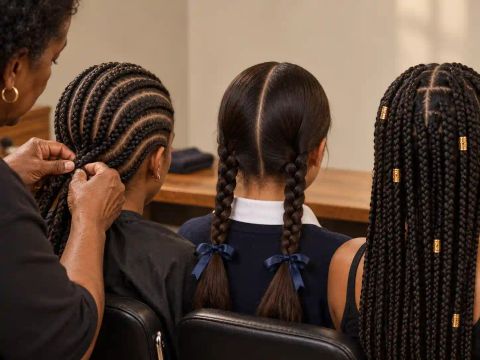
Braiding is one of the oldest and most widespread ways of dressing hair. But “braids” is not one style. A three-strand plait tied with a ribbon, cornrows laid close to the scalp and box braids with added hair have different techniques, histories and meanings, and we treat them separately.
Form and construction
- Three-strand plait: the hair is divided into three and the outer strands are crossed over the centre in turn.
- French and Dutch braids: hair from the scalp is added to each strand as the braid travels down the head. In a French braid the strands cross over; in a Dutch braid they cross under, so the braid stands out from the head.
- Cornrows: hair braided close to the scalp in rows, often in lines or curved patterns.
- Box braids: the hair is sectioned into squares and each section braided, often with added hair. “Knotless” braids begin with the wearer’s own hair and feed in extensions gradually.
Many braided and twisted forms have culture-specific names. We use them with attribution and do not present all African-derived practices as interchangeable. Pages on individual forms will be written with community review.
Documented wearers
Braided hair survives from the ancient world. A wig in the British Museum from Thebes, made around 1400 BCE, has curls on top and several hundred narrow plaits beneath, set with a mixture of beeswax and conifer resin; reconstructing it took a professional hairstylist about 200 hours.[1][2] Evidence status: Verified
The Smithsonian’s National Museum of African American History and Culture describes hair care and styling as ways of defining Black identities, and notes that some braided styles have conveyed background, status and life events.[3] The Smithsonian’s Center for Folklife and Cultural Heritage writes about hair as part of revitalised Black identity.[4] Evidence status: Verified
In Britain and Ireland, girls’ plaits tied with ribbons are a familiar sight in nineteenth- and twentieth-century photographs. Evidence status: Research That familiarity is not yet evidence of how common they were: a systematic survey of dated school and family photographs is still needed before we make claims about prevalence.
Age and life stage
Braids are often done to a child by someone else — a parent, grandparent, older sibling or friend — and the skill passes between generations. Evidence status: Interpretation That makes braiding a form of care, teaching and sometimes discipline, as well as a style: the hours spent braiding a child’s hair can be affection, obligation and creative work at once.
At school, braids have met rules. Evidence status: Current The Equality and Human Rights Commission’s guidance for schools in Britain says that a policy banning hairstyles associated with particular racial groups, without exceptions, is likely to be unlawful indirect discrimination — and it names braids, cornrows and plaits among them.[5] Its 2022 resources note that hair discrimination falls disproportionately on pupils with Afro-textured hair or hairstyles.[6] See Hair and school.
For adults, long braids could be pinned up — around the head or into a bun — for work or respectability. Evidence status: Research Who wore braids in this way, and when, is not yet documented on this site.
Meanings
Evidence status: Interpretation A braid can be practical, decorative, devotional, familial or political — sometimes all at once. Histories of Black braiding in particular risk being told only as stories of struggle; they are also stories of artistry, pleasure, business and community.
Appropriation, exchange and renaming
Evidence status: Interpretation In the 1990s and after, styles developed in Black communities were renamed, commercialised or praised when worn by white celebrities, while Black children and workers could be penalised for the same styles. Evidence status: Research Specific cases will be documented from dated media and policy evidence, not from anecdote, and we will not settle complex debates with a simple verdict.
Safety
Terminology
In British English “plait” was long the everyday word. Evidence status: Research “Braid” appears to have become more common in Britain over the late twentieth century, perhaps through American media; this still needs checking against dated sources.
How was it made?
-
Object · Prehistoric to present
The comb
The most ordinary hair tool, and one of the most revealing — from ancient carved combs to celluloid dressing-table sets, wide-toothed picks and heated pressing combs.
Sources
- British Museum, “Wig (EA2560)”. Accessed 12 November 2026. What it shows: Collection record for an 18th Dynasty (New Kingdom) wig of human hair from a tomb at Thebes, “impregnated with beeswax and resin”, with curls above narrow plaits; the record says it was “worn by a man of high status”. Also notes that false braids are known from the Predynastic Period and that wigs and wig boxes have been found in Twelfth Dynasty tombs at Lisht.
- Joann Fletcher and Filippo Salamone, “An Ancient Egyptian Wig: Construction and Reconstruction”, Internet Archaeology 42, 2016. Accessed 25 September 2026. What it shows: Study and reconstruction of British Museum wig EA2560 — an 18th-Dynasty "duplex" wig for a male official, once misidentified as a woman’s wig. Beeswax-and-resin setting; several hundred plaits; about 200 hours to reconstruct.
- Smithsonian National Museum of African American History and Culture, “Strands of Inspiration: Exploring Black Identities through Hair”, Smithsonian Institution. Accessed 25 September 2026. What it shows: Hair care and styling as ways of defining Black identities; braided styles that conveyed background, status and life events.
- Kamryn Z. Bess, “It’s More Than “Just” Hair: Revitalization of Black Identity”, Folklife Magazine, Smithsonian Center for Folklife and Cultural Heritage, 6 November 2022. Accessed 12 November 2026. What it shows: Draws on interviews with stylists and family memories to argue that hair is central to Black identity and that restoring respect for natural texture is part of revitalising it; mentions school hair discrimination and the CROWN Act.
- Equality and Human Rights Commission, “Preventing hair discrimination in schools”, published 27 October 2022. Accessed 25 September 2026. What it shows: Current guidance for schools in Britain. A policy banning hairstyles associated with particular racial or religious groups, without exceptions, is likely to be unlawful indirect discrimination; names Afro hairstyles, braids, locks, twists, cornrows, plaits, skin fades, head coverings and head wraps, and disability-related needs such as wigs during cancer treatment.
- Equality and Human Rights Commission, “Britain’s equality watchdog takes action to prevent hair discrimination in schools”, 27 October 2022. Accessed 25 September 2026. What it shows: Announcement of the 2022 resources, which note that hair discrimination disproportionately affects pupils with Afro-textured hair or hairstyles.
- British Association of Dermatologists, “Traction alopecia”, produced February 2019. Accessed 25 September 2026. What it shows: Patient information leaflet. Names tight ponytails, buns, braids, weaves and extensions, clips and tight head scarves; risk rises when combined with chemical relaxers. The leaflet’s own review date (February 2022) has passed.
Further reading
- Ayana D. Byrd and Lori L. Tharps, Hair Story: Untangling the Roots of Black Hair in America, St. Martin’s Press, 2001. details to check
- Emma Dabiri, Don’t Touch My Hair, Allen Lane, 2019. details to check An Irish-Nigerian writer on Black hair, history and culture.