Style
Locs
Rope-like strands formed as hair is allowed or encouraged to mat — worn across many cultures and faiths, and still penalised by some school and workplace rules.
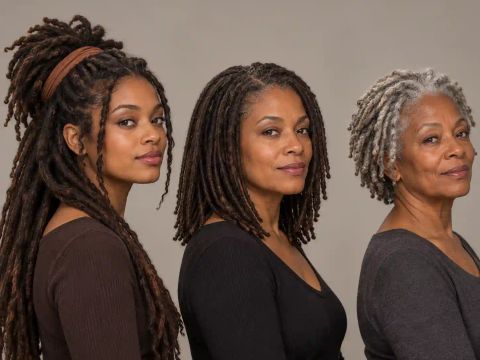
LocsHair that has been allowed or encouraged to mat and form rope-like strands. Worn across many cultures, with different names, methods and meanings. are strands of hair that have matted and bound together into rope-like lengths, whether allowed to form freely or started and maintained deliberately. They have been worn in many places, by many peoples, for many reasons — religious, cultural, political and aesthetic.
This page is an outline. We will write the full history of locs with community and faith-literate review, as our editorial policy requires, rather than generalise.
Form and construction
Locs can be started in several ways — by twisting, palm-rolling, braiding, interlocking or simply leaving hair to form — and then maintained over months and years. Evidence status: Research We have not yet gathered dated evidence for when particular methods became common in Britain, and will check this against salon records and photographs.
Meaning and faith
For many people, locs carry deep meaning. For some, including many Rastafari, they are a matter of faith. We will not summarise religious practice until it has been written and reviewed with people who hold it, so this section stays short until that work is done.
The Smithsonian’s National Museum of African American History and Culture describes hair care and styling as ways of defining Black identities.[3] Evidence status: Verified
School and work
Evidence status: Current The Equality and Human Rights Commission’s guidance for schools in Britain names locks among the hairstyles that a policy should not ban without the possibility of exceptions on racial or religious grounds.[1] See Hair and school.
Health
The British Association of Dermatologists notes that tight braids, including cornrows and locs (which it calls “dreadlocks”), can cause traction alopecia.[2] Evidence status: Verified
Terminology
“Dreadlocks” appears in historical sources and remains in use; many wearers prefer “locs” or “locks”. This site uses “locs” and quotes other terms as they appear.
Appropriation and exchange
Evidence status: Interpretation Locs are among the styles most often discussed in debates about appropriation — who is praised and who is punished for wearing them. We will document specific cases from dated evidence, and will not settle complex debates with a simple verdict.
Sources
- Equality and Human Rights Commission, “Preventing hair discrimination in schools”, published 27 October 2022. Accessed 25 September 2026. What it shows: Current guidance for schools in Britain. A policy banning hairstyles associated with particular racial or religious groups, without exceptions, is likely to be unlawful indirect discrimination; names Afro hairstyles, braids, locks, twists, cornrows, plaits, skin fades, head coverings and head wraps, and disability-related needs such as wigs during cancer treatment.
- British Association of Dermatologists, “Traction alopecia”, produced February 2019. Accessed 25 September 2026. What it shows: Patient information leaflet. Names tight ponytails, buns, braids, weaves and extensions, clips and tight head scarves; risk rises when combined with chemical relaxers. The leaflet’s own review date (February 2022) has passed.
- Smithsonian National Museum of African American History and Culture, “Strands of Inspiration: Exploring Black Identities through Hair”, Smithsonian Institution. Accessed 25 September 2026. What it shows: Hair care and styling as ways of defining Black identities; braided styles that conveyed background, status and life events.
Further reading
- Ayana D. Byrd and Lori L. Tharps, Hair Story: Untangling the Roots of Black Hair in America, St. Martin’s Press, 2001. details to check
- Emma Dabiri, Don’t Touch My Hair, Allen Lane, 2019. details to check An Irish-Nigerian writer on Black hair, history and culture.