2010–2019
The platform era
Tutorials, feeds and influencers; natural-hair communities and the debates they carried; ombré, beach waves and braids; pupils in Britain who challenged school hair rules; and women who stopped dyeing and said so in public.
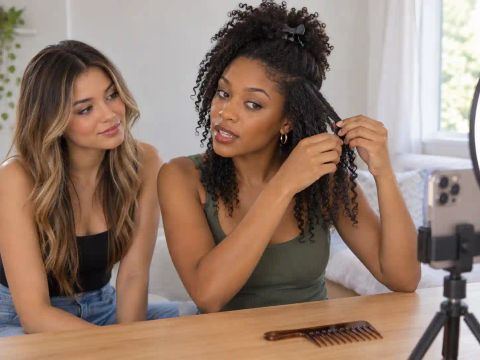
In the 2010s, much hair knowledge that had passed between relatives, friends and hairdressers also began to pass through screens. That did not mean everyone learned from video, or that online trends reached every street. This page records what we can date, and marks what still rests on impression.
Tutorials, feeds and influencers
YouTube was only five years old when the decade began: the V&A records that its first video was uploaded on 23 April 2005.[1] Evidence status: Verified Evidence status: Research Over the decade, step-by-step hair videos on YouTube, photographs on Instagram and saved image boards on Pinterest became familiar ways to learn a style. Instagram launched in Apple’s App Store on 6 October 2010.[2] Evidence status: Verified We have not yet confirmed Pinterest’s launch date from a primary source, and we have no reliable figures for how many people in Britain learned hair skills this way.
Evidence status: Interpretation Tutorials changed who counted as an expert. A teenager filming a braid in her bedroom could reach more viewers than a salon, and the camera rewarded styles that could be shown step by step. But the older routes did not vanish: many girls still learned to plait from a parent, sibling or friend, and a tutorial was often watched together.
Evidence status: Research Names that circulated widely — ombré and balayage colour, loose “beach waves”, the long bob or “lob”, shaved undercuts, pastel pinks and blues, and elaborate braids such as crown and fishtail plaits — still need dating from magazines, salon price lists and captured posts, with the platform and method recorded. We will not claim a style was universal because it trended.
Natural-hair communities
Online spaces supported many Black women in stopping chemical relaxers and learning to care for their natural texture. In October 2011 Deborah Gabriel, writing on her journalism site People With Voices, described “a vibrant and expanding community” of Black women in Britain “joining their American cousins” in embracing natural hair and sharing expertise on YouTube.[3] Evidence status: Verified
Evidence status: Interpretation The movement was social as well as practical: knowledge about washing, detangling, twisting and protective styles moved between viewers, often across the Atlantic. It was also commercial. Vloggers became product reviewers and sometimes entrepreneurs, and large brands launched ranges for curly and coily hair. Evidence status: Research British natural-hair meet-ups, shops and product businesses of the decade still need dated documentation. See Afro, locs and Black hair and identity.
The texture-classification debate
Many online discussions borrowed a letter-and-number chart devised in the 1990s by the stylist Andre Walker. The design podcast 99% Invisible reported in 2018 that the chart was created to sell his products, that people going natural found it online, and that critics argued natural-hair websites gave far more attention to looser curls than to the tightest textures.[4] Evidence status: Verified
Evidence status: Interpretation We do not use such numbers as categories on this site. A chart that places the tightest coils at the end of a scale can read as a ranking, even when it was not meant as one, and a single head of hair often has several textures. The debate itself — sometimes called “texturism” — is part of the decade’s history. We describe texture in words — wavy, curly, coily, Afro-textured — and say when a page’s scope is narrower.
Challenging school rules
Two cases in London schools, both supported by the Equality and Human Rights Commission (EHRC), drew national attention.
In 2017, Chikayzea Flanders, a pupil at Fulham Boys School, was told his locs broke the uniform policy. His family argued that his hair was symbolic of their culture and belief, and HuffPost UK reported in September 2018 that the EHRC-supported case had been settled.[7][6] Evidence status: Verified We include a boy’s case because it mattered for girls too; his mother said the case was also about “other young boys or girls”.[7] The religious side of the case, including Rastafari practice, will be written with faith-literate advisers.
Ruby Williams was repeatedly sent home from The Urswick School in Hackney in Years 10 and 11 under a policy stating that “afro style hair must be of reasonable size and length”. With EHRC funding, her claim was brought as race discrimination; in February 2020, when she was 18, it was reported that she had received an £8,500 out-of-court settlement. The school’s governors said they did not accept that it had discriminated.[5][6][12] Evidence status: Verified
Evidence status: Research Workplace cases in Britain in the 2010s — reported tribunal claims and settlements over braids, locs and Afro hair — still need to be gathered with dates from reliable sources.
Evidence status: Current Current guidance for schools in Britain says that a policy banning hairstyles associated with particular racial or religious groups, without exceptions, is likely to be unlawful indirect discrimination.[11] The Halo Code (2020) and the EHRC’s 2022 guidance are covered in the 2020s and Hair and school.
World Afro Day
World Afro Day says its founder, Michelle De Leon, established the Day on 15 September 2017, inspired by her daughter, as a focal point of pride and acceptance for Afro hair.[8] Evidence status: Verified Evidence status: Interpretation Alongside campaigns against discrimination, it placed celebration and children’s pleasure in their own hair at the centre — a reminder that Black hair history is not only a history of struggle.
Going grey in public
Online communities formed around stopping colouring. Martha Truslow Smith, a North Carolina graphic designer who found her first grey hair at 14, stopped dyeing at 24 and documented the change on the Instagram account Grombre.[10] Evidence status: Verified In November 2018, Positive News reported that she had stopped dyeing two years earlier, that Grombre had over 46,000 followers, and that a Facebook group, Gray and Proud, had close to 20,000 members; it also quoted a 44-year-old woman from Essex who had been inspired by Grombre.[9] Evidence status: Verified
Evidence status: Interpretation These communities cut across age: some members were in their twenties, others in midlife or older. They made visible a choice that older women had always made privately. Evidence status: Research We have not yet documented British grey-hair groups directly, or how many women actually stopped colouring; follower counts are not a measure of practice. See Grey hair, hair loss and wigs.
Age
Evidence status: Interpretation The decade’s best-documented hair stories in Britain were often about the young: school pupils challenging rules, teenagers filming tutorials, a day of celebration inspired by a founder’s young daughter. Older women appear most in the grey-hair communities. Evidence status: Research Girls under 13 were an audience for tutorials and toy-linked hair products, but their own accounts are not yet documented here. See Age and hair.
Styles, techniques and people from this period
-
1938–2023
Kwame Brathwaite
Harlem photographer whose pictures of the Grandassa Models and the “Naturally” fashion shows made natural hair a visible ideal of beauty in the early 1960s, and whose images reached Black publications in Britain at the time.
-
Essay
Black British hair
From suitcases packed with hot combs to Tottenham hair businesses, Brixton salons, Alexandra Palace hair shows and the Halo Code — a history of hair in Black British communities since 1945, told as skill, trade, family time and pleasure as well as struggle.
-
Essay
How trends travel
From engraved coiffure plates to TikTok, each new medium changed how fast a hairstyle could be seen. This essay follows the channels (prints, photographs, film, fan magazines, trade journals, television and platforms) and asks what evidence could ever show that a famous head caused many others to follow.
-
Essay
Rules about hair
Prisons, poorhouses, hospitals, kitchens, factories, schools and the army have all written rules about women’s and girls’ hair. This essay compares what the rules said with how they were enforced, separates genuine task-specific safety from demands for a particular look, and asks whose natural hair was treated as the problem — mainly in Britain, from the 1840s to today.
-
Style · Dressed style
The Afro
Coily hair worn in its own texture and shaped into a rounded form — a powerful image of pride and politics, and also a style people wore for many other reasons.
-
Style · Braided, twisted or locked
Braids and plaits
One of the oldest ways of dressing hair — and not one style but many, from a school plait tied with a ribbon to cornrows, box braids and ancient braided wigs.
-
Style · Braided, twisted or locked
Locs
Rope-like strands formed as hair is allowed or encouraged to mat — worn across many cultures and faiths, and still penalised by some school and workplace rules.
-
Theme
Black hair and identity
Hair as identity, family, artistry and enterprise — and as a target of racialised rules — told without reducing it to struggle alone.
-
Theme
Grey hair, hair loss and wigs
Greying, thinning, menopause, alopecia, chemotherapy, wigs and head coverings — treated as part of life and choice, not as problems to be fixed.
-
Theme
Hair and school
Plaits before the bell, rules about length and "extreme" styles, and whose natural hair has been treated as a problem — from written rules to how they were enforced.
Sources
- Victoria and Albert Museum, “Acquiring an early YouTube watch page and its first-ever video”, V&A, last updated 19 February 2026. Accessed 25 September 2026. What it shows: YouTube was registered as a company on 14 February 2005, its first video was uploaded on 23 April 2005 and it launched its first website in May 2005; the V&A collected a watch page dated 8 December 2006.
- MG Siegler, “Instagram Launches With The Hope Of Igniting Communication Through Images”, TechCrunch, 6 October 2010. Accessed 26 September 2026. details to check What it shows: Launch-day report that Instagram was "officially launching in the App Store".
- Deborah Gabriel, “UK naturals to watch: The YouTube vloggers”, People With Voices, 11 October 2011. Accessed 25 September 2026. What it shows: A dated 2011 profile describing a "vibrant and expanding community" of Black women in Britain sharing natural-hair experience and expertise on YouTube.
- 99% Invisible, “The Hair Chart”, 17 April 2018. Accessed 25 September 2026. What it shows: Radio/podcast episode on stylist Andre Walker's 1990s hair-typing chart, created to sell his products, its adoption by people turning to the internet for natural-hair advice, and criticism that sites favoured looser curls over tighter textures.
- Staff writer, “Student sent home over afro calls for schools to improve policies”, The Voice, 11 February 2020. Accessed 25 September 2026. What it shows: Ruby Williams, then 18, received an £8,500 out-of-court settlement after being repeatedly sent home from The Urswick School in Years 10 and 11 under a policy that "afro style hair must be of reasonable size and length"; the EHRC supported the case and the governors did not accept that the school had discriminated.
- Mark Smulian, “School agrees £8.5k settlement to pupil excluded over size of afro hair”, Local Government Lawyer, 13 February 2020. Accessed 25 September 2026. What it shows: Legal-press report that the EHRC funded Ruby Williams's claim as a race discrimination case, argued as indirect discrimination; the London Diocesan Board for Schools settled without admitting fault. Also notes the EHRC-funded 2017 Fulham Boys School locs case.
- Nadine White, “Mum Who Took Fulham School To Court Over Her Son's Dreadlocks Says It Was Never Just About Winning”, HuffPost UK, 13 September 2018. Accessed 25 September 2026. What it shows: Reports the settlement of the EHRC-supported case of Chikayzea Flanders, whose family argued his locs were symbolic of their culture and belief; his mother said the case was also about "other young boys or girls".
- World Afro Day, “Our Team”. Accessed 25 September 2026. What it shows: The organisation's own statement that founder Michelle De Leon established the Day on 15 September 2017, inspired by her daughter, as a focal point of pride and acceptance for Afro hair.
- Suzanne Bearne, “Roots manoeuvre: embracing grey hair”, Positive News, 19 November 2018. Accessed 25 September 2026. What it shows: Dated 2018 report on grey-hair communities, including the Instagram account Grombre (over 46,000 followers), a Facebook group with close to 20,000 members, and a 44-year-old woman from Essex inspired by Grombre.
- Michelle Ganley (Graham Media Group), “Going gray a little sooner than expected? Join the 'grombre' movement”, 11 May 2020. Accessed 25 September 2026. What it shows: Profile of Grombre founder Martha Truslow Smith, a North Carolina graphic designer who found her first grey hair at 14 and stopped dyeing at 24.
- Equality and Human Rights Commission, “Preventing hair discrimination in schools”, published 27 October 2022. Accessed 25 September 2026. What it shows: Current guidance for schools in Britain. A policy banning hairstyles associated with particular racial or religious groups, without exceptions, is likely to be unlawful indirect discrimination; names Afro hairstyles, braids, locks, twists, cornrows, plaits, skin fades, head coverings and head wraps, and disability-related needs such as wigs during cancer treatment.
- Holly Chant, “Family who battled against school hair policy to help write guidance”, Hackney Gazette. Accessed 12 November 2026. What it shows: On Ruby Williams and Urswick School. Quotes the governors: they “do not accept the school has discriminated, even unintentionally, against any individual or group”; says the settlement offer was made by the London Diocesan Board for Schools. The page shows no publication date (early 2020).
Further reading
- Emma Dabiri, Don’t Touch My Hair, Allen Lane, 2019. details to check An Irish-Nigerian writer on Black hair, history and culture.
- Ayana D. Byrd and Lori L. Tharps, Hair Story: Untangling the Roots of Black Hair in America, St. Martin’s Press, 2001. details to check
- Emma Tarlo, Entanglement: The Secret Lives of Hair, Oneworld, 2016. details to check An anthropology of the global trade in human hair, wigs and extensions, and of hair loss.
- Anne Kreamer, “Going Gray”, Little, Brown, 2007. details to check An American journalist's first-person account of stopping colouring her hair in midlife; not opened.