Theme
Grey hair, hair loss and wigs
Greying, thinning, menopause, alopecia, chemotherapy, wigs and head coverings — treated as part of life and choice, not as problems to be fixed.
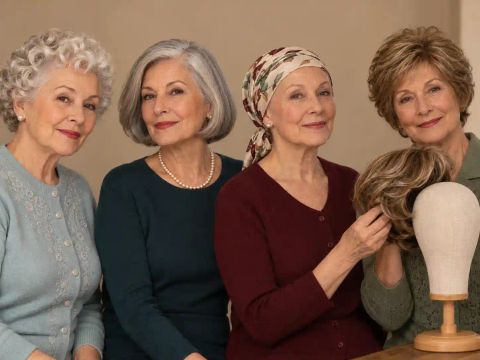
Fashion histories tend to stop looking at women once they are no longer coded as young. This hub gathers our work on greying, thinning and hair loss, and on the wigs, scarves, hats and head coverings that people choose — for comfort, for privacy, for style or for faith.
How we write about this
- We do not use before-and-after framing that presents grey hair, thinning or hair loss as a problem solved.
- We do not describe older people only by their age, and our image descriptions focus on hair, not on judgements of attractiveness.
- We treat the commercial “anti-ageing” frame as a subject of history, not as our own point of view.
Greying and colouring
Evidence status: Interpretation Whether to colour grey hair has long been presented to women as a question of respectability, employability and “letting oneself go”. The advertising that framed it that way is historical evidence; it is not evidence of what women actually felt or chose.
Colouring has its own risks. The NHS notes that many permanent and some semi-permanent hair dyes contain PPD, which can irritate skin or cause allergic reactions.[1] Evidence status: Verified
Evidence status: Research In the 2010s, online communities formed around stopping colouring and “going grey”; the dated evidence we have so far is on the 2010s page. We will write more here only with dated, captured evidence and a stated method, not from a handful of viral posts.
The weekly set
For many older women in Britain across the twentieth century, the weekly shampoo and set was both a hairstyle and a social institution. See Roller setting and the hair dryer.
Hair loss
Hair loss has many causes — genetics, menopause, illness and its treatment, stress and tension from hairstyles among them. The British Association of Dermatologists identifies repeated tension from tight styles as a cause of traction alopecia.[3] Evidence status: Verified
Children experience hair loss too. Evidence status: Current Current guidance for schools in Britain gives the example of pupils having cancer treatment who wear wigs, scarves or hats, and says schools may need to make exceptions to their rules.[2]
Wigs and coverings
Wigs are part of hair culture, not a disguise. See Wigs and hairpieces.
Questions we are researching
- How have menopause, ageing and hair loss been represented outside advertising?
- Who decides about an older woman’s hair when she needs care — at home or in a care home?
- How did wig provision through the NHS change over time?
Explore this theme
-
Object · 1880s to present in British collections
The hair dryer
From a stoneware bottle of boiling water to the row of humming salon hoods — how drying, the slowest part of every set, was turned into a machine.
-
Essay
Age and hair
Who decides how a girl’s hair is worn, when that power passes to her, and what happens to it again in old age — a history told across a lifetime rather than a decade.
-
Essay
From kitchen to salon
Most hair work has always been done unpaid, at home, by mothers, sisters, friends and women themselves. This essay follows that labour into the paid salon — a trade, a workplace, a women’s business and a meeting place — mainly in Britain and Ireland, with American and diasporic comparison.
-
Essay
Heat, electricity and chemistry
Taps, shampoo, tongs, dryers, perm machines, relaxers, synthetic dyes, plastics and fibres all changed what could be done with hair. This essay asks what each one cost in time, labour and money — and who could afford it — mainly in Britain, with American comparison.
-
Style · Dressed style
The bun and chignon
Hair gathered, coiled and pinned — a form that has meant imperial elegance, respectable adulthood, workplace safety and, lately, deliberate messiness.
-
Style · Addition or covering
Wigs and hairpieces
Added hair is part of hair culture, not "fake hair" — from ancient plaited wigs to Victorian switches, 1960s fashion wigs, extensions and wigs worn through illness.
-
Technique · Temporary setting
Roller setting
Winding damp hair on rollers and drying it in place — the engine of the weekly "shampoo and set" and of mid-century volume.
-
2010–2019
The platform era
Tutorials, feeds and influencers; natural-hair communities and the debates they carried; ombré, beach waves and braids; pupils in Britain who challenged school hair rules; and women who stopped dyeing and said so in public.
-
to c. 500 CE
Plaits, pins and portrait heads
What excavated hair, wigs, combs, pins and portrait sculpture can — and cannot — tell us about women's and girls' hair from Predynastic Egypt to Roman Britain, and which regional histories are still to be commissioned.
-
1500–1699
Courts, coifs and caps
High hairlines, hair dressed over pads, pearls, false hair and curls in court portraits — beside linen coifs, lice combs and recipe books that hint at how far more women in England and Scotland dealt with their hair between 1500 and 1699.
-
1789–1836
Revolution and Regency
Between the French Revolution and the 1830s, powder and height gave way to crops, classical curls, centre partings, knots and turbans — though “natural-looking” hair still took cutting, curling, pins and often false hair, and locks of hair were set into jewels for love, friendship and mourning.
-
1837–1900
Loops, nets and fringes
Six decades of changing shapes — smooth centre parts and side loops, netted chignons, false plaits and curled fringes — built with pins, pads and bought hair, some of it harvested from poorer women.
Sources
- NHS, “Hair dye reactions”, page last reviewed 29 December 2025. Accessed 25 September 2026. What it shows: Many permanent and some semi-permanent dyes contain PPD, which can irritate skin or cause allergic reactions.
- Equality and Human Rights Commission, “Preventing hair discrimination in schools”, published 27 October 2022. Accessed 25 September 2026. What it shows: Current guidance for schools in Britain. A policy banning hairstyles associated with particular racial or religious groups, without exceptions, is likely to be unlawful indirect discrimination; names Afro hairstyles, braids, locks, twists, cornrows, plaits, skin fades, head coverings and head wraps, and disability-related needs such as wigs during cancer treatment.
- British Association of Dermatologists, “Traction alopecia”, produced February 2019. Accessed 25 September 2026. What it shows: Patient information leaflet. Names tight ponytails, buns, braids, weaves and extensions, clips and tight head scarves; risk rises when combined with chemical relaxers. The leaflet’s own review date (February 2022) has passed.
Further reading
- Emma Tarlo, Entanglement: The Secret Lives of Hair, Oneworld, 2016. details to check An anthropology of the global trade in human hair, wigs and extensions, and of hair loss.
- Rose Weitz, Rapunzel’s Daughters: What Women’s Hair Tells Us About Women’s Lives, Farrar, Straus and Giroux, 2004. details to check