to c. 500 CE
Plaits, pins and portrait heads
What excavated hair, wigs, combs, pins and portrait sculpture can — and cannot — tell us about women's and girls' hair from Predynastic Egypt to Roman Britain, and which regional histories are still to be commissioned.
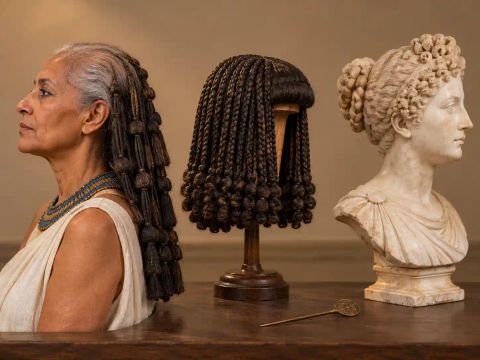
This essay covers a vast span — more than three and a half thousand years — and deliberately does not try to describe “ancient women’s hair”. It looks closely at a few well-documented finds from Egypt, the Roman world and Roman Britain, says what each can prove, and marks where specialist regional essays are still to come. Most of what survives is either buried hair and tools, or images made to flatter the powerful; neither is a record of an ordinary morning.
Egypt: extensions, wigs, tongs and combs
Some of the oldest surviving evidence for added hair belonged to an older woman. At Hierakonpolis in Upper Egypt, in the non-elite cemetery HK43 (Naqada IIB–IIC, roughly 3650–3500 BCE), the excavators describe Burial 16, an older woman who “dyed her greying tresses with henna, and plumped out her thinning locks with hair extensions, knotted into the natural hair”.[1] Evidence status: Verified The same cemetery included a woman of about 45 buried with a bone hair comb that had already lost a tine, and a woman of 40–50 whose basket held an ivory hair comb alongside cosmetics.[1] Evidence status: Verified Evidence status: Research The excavators’ detailed reports still need checking for how the extensions were made and what the hair itself was like. See wigs and hairpieces and the comb.
Evidence status: Interpretation These are not queens. A worn comb and extensions knotted into thinning grey hair suggest care for appearance in midlife and older age among ordinary people — a useful corrective to histories that begin with young, elite women.
The best-studied Egyptian wig in a British collection, British Museum EA2560 (about 1400 BCE), is made of human hair: a top section of curls over an underpanel of several hundred plaits, set with beeswax and conifer resin. It is a “duplex” wig of the kind worn by male officials, and was once wrongly called a woman’s wig.[2] Evidence status: Verified We include it for what it shows about skill and materials, not as evidence of women’s practice.
Tools survive too. The Science Museum Group holds bronze curling tongs combined with a trimmer, dated 1575–1194 BCE.[3] Evidence status: Verified See curling tongs. The Fitzwilliam Museum and Museum of Archaeology and Anthropology exhibition Origins of the Afro Comb followed “the evolution of the comb from pre-dynastic Egypt to modern-day”, tracing similarities in form across Africa and the African diaspora.[4] Evidence status: Verified See the Afro.
Greece and Rome
Evidence status: Research Greek dressing of women’s hair — bands, veils, braids and knots — is known largely from vase painting and sculpture. We have not yet checked this against museum catalogues, and will not describe it until we have.
Roman imperial portrait sculpture records elaborate ringlets, rolls and looped braids. The Metropolitan Museum’s catalogue of its Roman portraits describes hairstyle fashions as typically starting with the imperial family and spreading as new portraits of the rulers were distributed.[5] Evidence status: Verified Evidence status: Research We have checked only the publisher’s summary of the catalogue on this point; how far imperial women set rather than followed fashions still needs checking against specialist studies. Evidence status: Interpretation But a marble head is an official ideal. It tells us what a powerful family wished to be seen wearing, not how long a style took, who dressed it, or what girls, servants or older women in the provinces wore. See the bun.
Pins held many of these styles together. The Science Museum Group’s 124 mm Roman bronze hairpin, its head decorated with a boy’s head, is dated broadly between 199 BCE and 500 CE.[6] Evidence status: Verified See the hairpin.
Roman Britain: hair from York
In Roman York, some bodies were buried in coffins filled with gypsum, which occasionally preserved hair. The Royal Commission’s inventory records a burial containing “an adolescent girl whose auburn hair, fastened in a bun by two jet pins, is preserved in the Yorkshire Museum”, and another in which “auburn hair in ringlets survived”.[8] Evidence status: Verified The York Museums Trust catalogues the first find as a “Hair piece” of 250–410 CE, with two jet pins with cantharus (cup-shaped) heads still in place, and quotes a nineteenth-century account calling it “the back hair … of a young Roman lady”.[7] Evidence status: Verified
Evidence status: Research The two descriptions differ: “adolescent girl” and “young Roman lady” both rest largely on the 1875 discovery. We still need to find whether age and sex have been re-examined with modern methods, whether the colour is original or changed in the ground, and whether the bun is all her own hair or includes added hair.
Evidence status: Interpretation Even so, this is exceptional evidence: a real, dated arrangement of a young person’s hair from Britain, fastened with jet pins, rather than known only from a portrait.
Reconstructed and documented technique
The line between what we know and what we reconstruct matters most for this period.
- Documented directly: extensions knotted into natural hair (HK43); plaits and curls set with beeswax and resin (EA2560); a bun held with two jet pins (York).
- Reconstructed: how long a style took and how it was made. Recreating EA2560 took a professional hairstylist about 200 hours[2] Evidence status: Verified — a measure of a modern reconstruction, not proof of ancient working time.
- Inferred from images: Roman portrait styles, whose structure may have relied on additions, pads or sculptors’ licence. Evidence status: Research Claims about Roman women’s routines built from sculpture alone still need checking against surviving objects.
Age and life stage
Evidence status: Interpretation The finds here reach across ages that fashion histories often skip: an older woman with greying hair and extensions, women in their forties buried with their own combs, and a young person in York whose hair was pinned up for burial. What they cannot tell us is who did the hair — the wearer, a relative, a servant or an enslaved hairdresser — or what childhood styles looked like. We have not yet found well-documented evidence for young children’s hair in this period.
Hair textures
Evidence status: Research The surviving evidence does not let us describe the hair textures of the people discussed here in any systematic way, and we have not yet checked fibre studies of the HK43 hair. This essay’s scope is therefore narrower than we would like.
Regional essays still to commission
This page is not a history of the ancient world. We are commissioning separate essays, written by regional specialists from local archaeology, art and texts, on:
- Han China and its neighbours;
- South Asia, from sculpture and texts;
- African archaeological and visual evidence beyond Egypt;
- Indigenous American practices, written with the communities concerned;
- ancient West Asian head coverings, including law codes and images.
Until they are written we make no claims about these regions here.
Styles, techniques and people from this period
-
Object · Prehistoric to present
The comb
The most ordinary hair tool, and one of the most revealing — from ancient carved combs to celluloid dressing-table sets, wide-toothed picks and heated pressing combs.
-
Object · c. 1575 BCE to present
Curling tongs and the Marcel iron
Heated metal pincers for curling and waving hair — a tool with a history of more than three thousand years, from Egyptian bronze to the salon Marcel iron.
-
Object · Ancient to present
The hairpin
The small, easily lost tool that holds up almost every dressed style in history — from decorated Roman bronze to the mass-produced wire grip.
-
Style · Braided, twisted or locked
Braids and plaits
One of the oldest ways of dressing hair — and not one style but many, from a school plait tied with a ribbon to cornrows, box braids and ancient braided wigs.
-
Style · Dressed style
The bun and chignon
Hair gathered, coiled and pinned — a form that has meant imperial elegance, respectable adulthood, workplace safety and, lately, deliberate messiness.
-
Style · Addition or covering
Wigs and hairpieces
Added hair is part of hair culture, not "fake hair" — from ancient plaited wigs to Victorian switches, 1960s fashion wigs, extensions and wigs worn through illness.
Sources
- Hierakonpolis Expedition, The Workers’ cemetery – HK43, Hierakonpolis Online. Accessed 25 September 2026. What it shows: Predynastic cemetery at Hierakonpolis, Upper Egypt. Burial 16, an older woman, had hair extensions knotted into her own thinning hair and henna on greying hair.
- Joann Fletcher and Filippo Salamone, “An Ancient Egyptian Wig: Construction and Reconstruction”, Internet Archaeology 42, 2016. Accessed 25 September 2026. What it shows: Study and reconstruction of British Museum wig EA2560 — an 18th-Dynasty "duplex" wig for a male official, once misidentified as a woman’s wig. Beeswax-and-resin setting; several hundred plaits; about 200 hours to reconstruct.
- Science Museum Group, “Bronze hair curling tongs and trimmer, Egypt, 1575–1194 BCE (A634869)”. Accessed 25 September 2026. What it shows: A bronze tool combining curling tongs and a trimmer, from Sir Henry Wellcome’s collection.
- University of Cambridge, “Origins of the Afro Comb: 6,000 years of culture, politics and identity”, 2 July 2013. Accessed 25 September 2026. What it shows: On the Fitzwilliam Museum and Museum of Archaeology and Anthropology exhibition (curated by Sally-Ann Ashton), tracing the comb from pre-dynastic Egypt to today and "the politicising and popularisation of Afros and Dreadlocks", with community hair stories.
- Paul Zanker, Roman Portraits: Sculptures in Stone and Bronze in the Collection of The Metropolitan Museum of Art, Metropolitan Museum of Art, 2016. Accessed 25 September 2026. What it shows: Catalogue of Roman portrait sculpture; hairstyle fashions spread from the imperial family with its portraits. Sculpture shows official and elite ideals, not everyday routines.
- Science Museum Group, “Hairpin, bronze, decorated with boy’s head, Roman (A624626)”. Accessed 25 September 2026. What it shows: A 124 mm bronze pin with a decorative head, dated broadly 199 BCE–500 CE.
- York Museums Trust, “Hair piece (YORYM : 1998.695)”, York Museums Trust (Yorkshire Museum), 250–410 CE (object date). Accessed 25 September 2026. What it shows: Collection record for preserved Roman-period hair from a York burial in a sarcophagus with a lead coffin and gypsum, with two jet pins with cantharus-shaped heads still in the hair; quotes a nineteenth-century account calling it "the back hair ... of a young Roman lady".
- Royal Commission on Historical Monuments (England), “Roman York: Burials”, An Inventory of the Historical Monuments in City of York, Volume 1, Eburacum, Roman York, HMSO (London), via British History Online, 1962. Accessed 25 September 2026. What it shows: Official inventory of Roman burials in York; records gypsum burials that preserved hair, including "an adolescent girl whose auburn hair, fastened in a bun by two jet pins, is preserved in the Yorkshire Museum" (p. 83) and another burial in which "auburn hair in ringlets survived" (p. 81).
Further reading
- Emma Tarlo, Entanglement: The Secret Lives of Hair, Oneworld, 2016. details to check An anthropology of the global trade in human hair, wigs and extensions, and of hair loss.