
Style
Wigs and hairpieces
Added hair is part of hair culture, not "fake hair" — from ancient plaited wigs to Victorian switches, 1960s fashion wigs, extensions and wigs worn through illness.
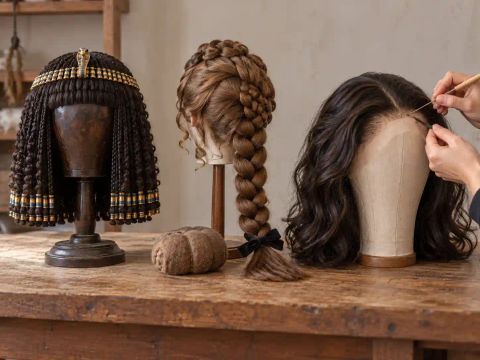
Wigs, hairpieces, switches, falls, extensions and weaves are all ways of adding hair. This site treats them as part of hair culture — skilled, social and often deeply personal — not as “fake hair”.
Ancient wig making
Some of the oldest surviving added hair belonged to a woman. At Hierakonpolis in Upper Egypt, in a Predynastic workers’ cemetery (HK43, which the excavators date to Naqada IIB–IIC, roughly 3650–3500 BCE), an older woman (Burial 16) had “plumped out her thinning locks with hair extensions, knotted into the natural hair to create an elaborate hairstyle”, and had used henna on greying hair.[1] Evidence status: Verified Evidence status: Research The excavators’ detailed reports still need checking for a date for this burial in particular, and for how the extensions were made.
One of the best-studied ancient wigs, in the British Museum, was made around 1400 BCE from human hair: curls over several hundred plaits, set with a mixture of beeswax and conifer resin. Recreating it took a professional hairstylist around 200 hours. It is in the “duplex” style typical of male officials (it was once wrongly called a woman’s wig).[2][3] Evidence status: Verified We include it here for what it shows about skill and materials, not as evidence of women’s practice. See Braids and plaits.
Additions in everyday dressing
For much of the nineteenth and early twentieth centuries, fashionable dressed hair relied on additions: switchesA length of real or synthetic hair, gathered at one end, added to the wearer’s own hair to make braids, coils or buns fuller. of extra hair to make braids and coils fuller, and pads or ratsA pad or cushion, often made from the wearer’s own saved combings, placed under the hair to give it volume or height. Used under eighteenth-century dressed hair, Victorian and Edwardian styles, and 1940s rolls. to give volume. Evidence status: Research How widely ordinary women used them, and where the hair came from, still needs checking against catalogues and trade records.
Wig making was a professional craft with its own tools. The V&A holds iron curling tongs made in Britain around 1900 and used by wig makers, given by Wig Creations Ltd to its Theatre and Performance collection.[4] Evidence status: Verified
Fashion wigs
Evidence status: Research In the 1960s, wigs and hairpieces were widely advertised as fashion accessories — a way to change style without changing one’s own hair. Sales figures and who bought them still need checking.
Wigs, illness and hair loss
Wigs, scarves and hats are worn by many people experiencing hair loss, including through illness and its treatment. Current guidance for schools in Britain gives the example of pupils having cancer treatment who wear wigs, scarves or hats, for whom schools may need to make exceptions.[5] Evidence status: Current
We treat hair loss with dignity. See Grey hair, hair loss and wigs.
Faith
For some religious communities, covering one’s own hair — including with a wig — is a matter of observance. We will write about this only with faith-literate advisers, and will not generalise across communities.
Where the hair comes from
Evidence status: Interpretation Human hair for wigs and extensions has long been traded internationally, often from poorer to richer places. Emma Tarlo’s Entanglement follows that trade through wig factories, temples and shops, and is our starting point for a future page on its labour and ethics.
How was it made?
-
Object · c. 1575 BCE to present
Curling tongs and the Marcel iron
Heated metal pincers for curling and waving hair — a tool with a history of more than three thousand years, from Egyptian bronze to the salon Marcel iron.
Sources
- Hierakonpolis Expedition, The Workers’ cemetery – HK43, Hierakonpolis Online. Accessed 25 September 2026. What it shows: Predynastic cemetery at Hierakonpolis, Upper Egypt. Burial 16, an older woman, had hair extensions knotted into her own thinning hair and henna on greying hair.
- British Museum, “Wig (EA2560)”. Accessed 12 November 2026. What it shows: Collection record for an 18th Dynasty (New Kingdom) wig of human hair from a tomb at Thebes, “impregnated with beeswax and resin”, with curls above narrow plaits; the record says it was “worn by a man of high status”. Also notes that false braids are known from the Predynastic Period and that wigs and wig boxes have been found in Twelfth Dynasty tombs at Lisht.
- Joann Fletcher and Filippo Salamone, “An Ancient Egyptian Wig: Construction and Reconstruction”, Internet Archaeology 42, 2016. Accessed 25 September 2026. What it shows: Study and reconstruction of British Museum wig EA2560 — an 18th-Dynasty "duplex" wig for a male official, once misidentified as a woman’s wig. Beeswax-and-resin setting; several hundred plaits; about 200 hours to reconstruct.
- Victoria and Albert Museum, “Curling tongs (S.496-1984)”, about 1900. Accessed 25 September 2026. What it shows: Iron tongs opening like scissors, made in Great Britain around 1900 and used by wig makers; given by Wig Creations Ltd to the museum’s Theatre and Performance collection.
- Equality and Human Rights Commission, “Preventing hair discrimination in schools”, published 27 October 2022. Accessed 25 September 2026. What it shows: Current guidance for schools in Britain. A policy banning hairstyles associated with particular racial or religious groups, without exceptions, is likely to be unlawful indirect discrimination; names Afro hairstyles, braids, locks, twists, cornrows, plaits, skin fades, head coverings and head wraps, and disability-related needs such as wigs during cancer treatment.
Further reading
- Emma Tarlo, Entanglement: The Secret Lives of Hair, Oneworld, 2016. details to check An anthropology of the global trade in human hair, wigs and extensions, and of hair loss.
- Geraldine Biddle-Perry and Sarah Cheang (eds), Hair: Styling, Culture and Fashion, Berg, 2008. details to check Cross-cultural essays on hair in fashion, film, art, history and consumer culture.