
Object
Curling tongs and the Marcel iron
Heated metal pincers for curling and waving hair — a tool with a history of more than three thousand years, from Egyptian bronze to the salon Marcel iron.
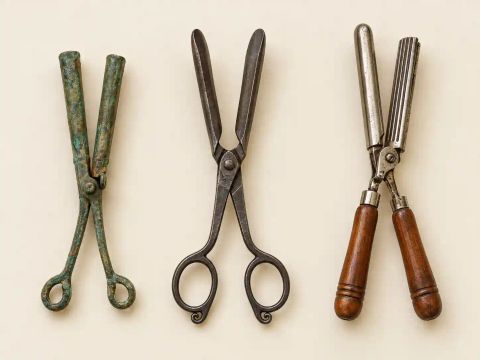
Heated tongs are among the oldest hair tools that survive. Their basic form — two metal arms closing on a section of hair — has changed less than almost any other styling tool.
Three thousand years of tongs
- Egypt, 1575–1194 BCE: the Science Museum Group holds bronze curling tongs combined with a hair trimmer. The museum notes that hairdressing was an important part of social life in ancient Egypt, “particularly true among the wealthier classes”.[1] Evidence status: Verified
- Britain, about 1900: iron curling tongs “opening, like scissors, to allow hair to be placed between the ‘blades’”, used by wig makers and given to the V&A’s Theatre and Performance collection by the wig makers Wig Creations Ltd.[2] Evidence status: Verified
- Britain, 1920: “tongs for flat curls”, given to the Science Museum Group together with a gas-heated pedestal dryer of the same date.[3] Evidence status: Verified
The Marcel iron
The Marcel iron is a heated tong designed to make a deep, regular wave rather than a round curl. It takes its name from the French hairdresser Marcel Grateau. See Marcel waving.
Heat, skill and risk
Before thermostats, the user had to judge the heat. Evidence status: Research Hairdressers are often said to have tested their irons on paper before touching hair; we are checking this against dated manuals. Evidence status: Interpretation Either way, skill lay as much in managing temperature as in forming the wave.
Object story
- What is it made of, and how does it work?
- Two arms hinged like scissors or pincers, one often rounded and one grooved, heated and closed on a section of hair. Before electric versions, the tongs were heated separately and their temperature judged by the user.
- Who made and sold it?
- Ancient and early examples are unattributed. The makers of later salon irons still need to be identified from catalogues and marks.
- Who used it — at home, in the salon, at work?
- Wealthy households with servants or hairdressers in the ancient world; professional wig makers and hairdressers in the nineteenth and twentieth centuries; and women at home.
- What signs of use should we look for?
- Scorching and discoloration from repeated heating, and wear to the hinge.
- Where can dated examples be seen?
- Dated examples in the Science Museum Group (Egypt, 1575–1194 BCE; 1920) and the V&A (Britain, about 1900).
Used for
-
Technique · Temporary setting
Marcel waving
A deep, regular wave made with heated irons — a salon skill that shaped late-Victorian, Edwardian and 1920s hair, and a staple of Black beauty culture.
Sources
- Science Museum Group, “Bronze hair curling tongs and trimmer, Egypt, 1575–1194 BCE (A634869)”. Accessed 25 September 2026. What it shows: A bronze tool combining curling tongs and a trimmer, from Sir Henry Wellcome’s collection.
- Victoria and Albert Museum, “Curling tongs (S.496-1984)”, about 1900. Accessed 25 September 2026. What it shows: Iron tongs opening like scissors, made in Great Britain around 1900 and used by wig makers; given by Wig Creations Ltd to the museum’s Theatre and Performance collection.
- Science Museum Group, “Tongs for flat curls, 1920 (1976-29)”. Accessed 25 September 2026.
Further reading
- Caroline Cox, Good Hair Days: A History of British Hairstyling, Quartet Books, 1999. details to check A general history of British hairdressing and styles.