Technique
Marcel waving
A deep, regular wave made with heated irons — a salon skill that shaped late-Victorian, Edwardian and 1920s hair, and a staple of Black beauty culture.
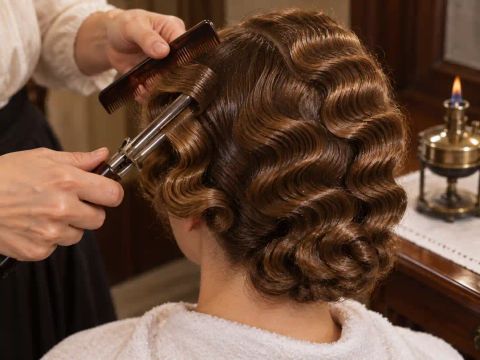
A Marcel waveA deep, regular wave made with heated curling tongs, named after the French hairdresser Marcel Grateau. The dates and patents behind the name still need checking. is a deep, even, regular wave made with heated irons on dry hair. Where a finger wave is moulded wet and left to dry, a Marcel wave is pressed into the hair with heat, section by section.
How it worked
The operator held a section of hair with a comb and closed the heated iron on it, turning the iron to form a ridge, then moved along to form the next ridge in the opposite direction. The result looked like a natural wave rather than a round curl. This is a summary of historical practice, not instructions.
Evidence status: Research The exact grip, the number of passes and the temperature varied between teachers and manuals; we are still checking these against dated hairdressing textbooks.
Origins and names
The technique is named after the French hairdresser Marcel Grateau. Evidence status: Research It is usually dated to 1872, though some accounts give 1875; US patents for curling and waving irons in the early twentieth century were granted to New York hairdressers named Marcel, and whether any of them was Grateau is doubtful. French patents in his own name still need checking. See Marcel Grateau. Heated tongs themselves are far older — see curling tongs.
Where it fits in the history
Marcel waving was a salon skill that suited the dressed hair of the late nineteenth and early twentieth centuries, and it remained important into the 1920s, when short, waved bobs needed regular re-waving.
In the United States, Annie Turnbo Malone’s Poro company advertised a “Marcel Waving Iron” and a “Marcel Comb” to its agents; the Marcel Comb was used to straighten hair before waving it.[1] Evidence status: Verified Evidence status: Research British practice is not yet documented.
Skill and time
Evidence status: Interpretation Because a Marcel wave lasted only until the hair was washed or became damp, it created regular, repeat business for salons — one reason the permanent wave, when it arrived, was sold as a convenience.
Tools and styles
-
Object · c. 1575 BCE to present
Curling tongs and the Marcel iron
Heated metal pincers for curling and waving hair — a tool with a history of more than three thousand years, from Egyptian bronze to the salon Marcel iron.
-
Object · Prehistoric to present
The comb
The most ordinary hair tool, and one of the most revealing — from ancient carved combs to celluloid dressing-table sets, wide-toothed picks and heated pressing combs.
Sources
- Moriah James, “Sizzle”, Smithsonian Institution, 10 January 2019. Accessed 25 September 2026. What it shows: On the pressing (hot) comb. Corrects the misconception that Madam C. J. Walker invented it; she and her “hair culturists” regularly used it, and her textbook taught a straightening process, though she said her products were for healthy hair. Also lists Poro’s “Marcel Waving Iron” and “Marcel Comb”, and combs heated on the kitchen stove.
Further reading
- Caroline Cox, Good Hair Days: A History of British Hairstyling, Quartet Books, 1999. details to check A general history of British hairdressing and styles.
- Noliwe M. Rooks, Hair Raising: Beauty, Culture, and African American Women, Rutgers University Press, 1996. details to check