Style
The bob
A family of short cuts whose meanings kept changing — from a 1920s statement to 1960s geometry to a style so familiar it now barely registers.
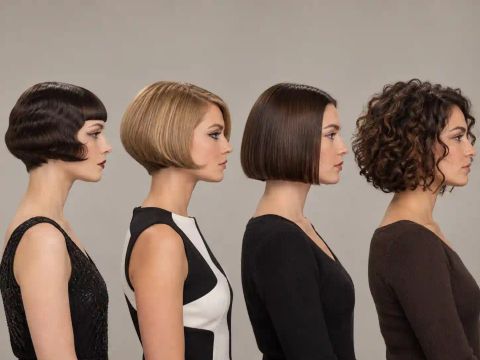
A bob is a cut, not a set: its shape comes from where the hair is cut, usually somewhere between the ear and the jaw. It is also not one style but a family — shingled, waved, blunt, graduated, geometric and layered — whose members have meant very different things to different wearers.
Form and construction
The 1920s family included the shingleA bob cut very short and tapered at the nape so that the back lies close to the head, often with waves at the sides., tapered close at the nape so that the back of the head showed its shape, and the even shorter Eton cropA very short, close cut of the mid-to-late 1920s, named after the boys’ school. Among the shortest fashionable women’s cuts of the decade.. Many bobs were then dressed as well as cut: waved with the fingers and a comb (a finger waveA set in which wet hair is shaped with the fingers and a comb into ridges that run in an S-pattern across the head, then left to dry in place.), with heated tongs, or with a permanent waveA process that changes the shape of the hair until it grows out, by chemically breaking and re-forming bonds in the hair. Early machine methods used heat as well as chemicals; “cold waves” did not..
Evidence status: Research Razors as well as scissors were used to cut close at the nape. Whether women’s bobs in 1920s Britain were mostly cut by hairdressers or by barbers — and what that meant for cost and respectability — still needs checking against trade journals and salon records.
Documented wearers
The London Museum’s Beatrice Behlen explains that in the early 1920s many women kept their hair long but simulated a bob — putting it up at the back and teasing curls out at the front. Only in the mid-1920s did short hair become ubiquitous, “leading all the way to the so-called Eton crop”.[1] Evidence status: Verified The look arrived before many women were ready to cut.
Film made particular silhouettes instantly recognisable. Louise Brooks had her hair cut in 1924 at Saveli’s salon in New York — a fringe above the eyebrows, points at the cheekbones and a shingled back — and kept it for Pandora’s Box (1929). The BFI traces how this “Lulu bob” became one of cinema’s most imitated haircuts, noting that most imitators “stop short of the shingle”.[2] Evidence status: Verified That shows reputation and influence, not invention: Brooks made one version of the bob famous; she did not create the family.
Newspapers are a route to ordinary wearers and to the arguments about them. The Library of Congress guide to “flappers” in digitised American newspapers is a starting point for the United States.[3] Evidence status: Research We have not yet sampled British and Irish newspapers systematically, so claims here about how widespread the bob was in Britain rest on museum interpretation until that is done.
Age and life stage
Evidence status: Interpretation In 1920s commentary, young women carried the strongest associations with rebellion, but the simplified silhouette spread well beyond the “flapper”. A bob could signal fashion, generational conflict, practicality or simply convenience.
- School-age girls: short cuts with a straight fringe — sometimes called a Dutch bob — appear often in photographs of children. Evidence status: Research How common they were, and whether practicality, lice control or fashion drove them, still needs school photographs to check.
- Teenagers and young adults: the age group at the centre of 1920s arguments about bobbing, and of 1960s geometric cuts.
- Midlife and older women: Evidence status: Research when older women adopted the bob, and how commentators treated them when they did, is not yet documented on this site.
Meanings
Evidence status: Interpretation It is tempting to read the 1920s bob as a feminist act. For some wearers it may have been. But cutting one’s hair could mean fashion, practicality, modernity, youth or conformity to a new norm — and many women who kept long hair were not conservatives. We do not assume one meaning from the length of someone’s hair.
Texture and scope
Evidence status: Research Most images of 1920s bobs in the collections we have consulted so far show straight or wavy hair. We have not yet found British evidence about how women with curly and coily hair wore short cuts in the 1920s. The widely available pressing comb[4] is one likely route to investigate, not a conclusion.
Revivals
- 1960s: precision geometric cutting made the bob a showcase of the cutter’s skill. See Vidal Sassoon for what can and cannot be claimed about his role.
- 1990s: minimalist bobs and crops sat alongside long, layered cuts.
- 2020s: Evidence status: Current bobs appear among current trend names. We treat such names as dated snapshots, not lasting categories.
Terminology
“Bob”, “bobbed” and “bobbing” were all in use by the 1920s. Names such as shingle and Eton crop are period terms; lob (long bob) is much later. Evidence status: Research When each name entered British trade vocabulary, rather than being applied later, still needs to be checked against dated trade journals.
How was it made?
-
Technique · Temporary setting
Finger waving
Shaping wet hair with fingers and a comb into rippling S-shaped ridges — the signature set of the late 1920s and 1930s, and a test of skill.
-
Object · Prehistoric to present
The comb
The most ordinary hair tool, and one of the most revealing — from ancient carved combs to celluloid dressing-table sets, wide-toothed picks and heated pressing combs.
Sources
- Beatrice Behlen, “Women’s fashion in 1920s London: Going out!”, London Museum, 6 January 2022. Accessed 25 September 2026. What it shows: Early in the decade women kept long hair but put it up at the back and teased curls out at the front to look bobbed; only in the mid-1920s did short hair become ubiquitous, leading to the Eton crop.
- Pamela Hutchinson, “How the Lulu bob became cinema’s most imitated haircut”, BFI, 29 May 2018, updated 9 November 2020. Accessed 25 September 2026. What it shows: Brooks had her bob cut in 1924 at Saveli’s New York salon and kept it for Pandora’s Box (1929); traces later imitations. Repeats the claim that Antoine de Paris cut the first ladies’ bob in 1909.
- Library of Congress, “Flappers: topics in Chronicling America”. Accessed 19 September 2026. What it shows: Research guide to digitised American newspapers; a route to primary reporting on bobbed hair.
- Moriah James, “Sizzle”, Smithsonian Institution, 10 January 2019. Accessed 25 September 2026. What it shows: On the pressing (hot) comb. Corrects the misconception that Madam C. J. Walker invented it; she and her “hair culturists” regularly used it, and her textbook taught a straightening process, though she said her products were for healthy hair. Also lists Poro’s “Marcel Waving Iron” and “Marcel Comb”, and combs heated on the kitchen stove.
Further reading
- Caroline Cox, Good Hair Days: A History of British Hairstyling, Quartet Books, 1999. details to check A general history of British hairdressing and styles.
- Geraldine Biddle-Perry and Sarah Cheang (eds), Hair: Styling, Culture and Fashion, Berg, 2008. details to check Cross-cultural essays on hair in fashion, film, art, history and consumer culture.