Technique
Finger waving
Shaping wet hair with fingers and a comb into rippling S-shaped ridges — the signature set of the late 1920s and 1930s, and a test of skill.
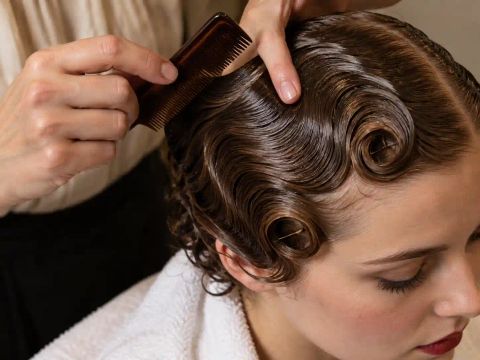
A finger waveA set in which wet hair is shaped with the fingers and a comb into ridges that run in an S-pattern across the head, then left to dry in place. is a set: a temporary shape given to damp hair that holds once the hair dries. Unlike Marcel wavingA deep, regular wave made with heated curling tongs, named after the French hairdresser Marcel Grateau. The dates and patents behind the name still need checking., which used heated tongs, finger waving needed no heat to form the wave — only wet hair, a comb, setting lotion and practised fingers.
How it worked
Wet hair can be moulded because water temporarily breaks some of the weak hydrogen bonds that hold its shape; as it dries, the hair keeps the shape it was held in. That is why a finger wave lasts only until the hair is wetted or brushed out. Our explanations of hair chemistry are general and are awaiting expert review.
The sequence, summarised from historical practice
- The hair was washed and left damp, and setting lotion combed through.
- A parting was made and the hair combed smooth in one direction.
- A finger was pressed against the head and the hair combed forward and then back, pushing up a ridge.
- The ridge was held — with fingers, then with clips — while the next was formed in the opposite direction, building an S-shaped ripple down the head.
- The ends were often wound into pin curlsA small curl wound flat against the head and held with a pin or clip while it sets..
- The set was left to dry, often under a net, before the clips were removed.
Evidence status: Research This summary still needs checking against dated manuals, which will tell us how the sequence and products varied between salons and home practice.
Where it fits in the history
Finger waves suited the short bobsA family of short cuts, usually between ear and jaw length, cut to a clean line or graduated at the nape. Not one style but many — shingled, waved, blunt, geometric and layered. and shinglesA bob cut very short and tapered at the nape so that the back lies close to the head, often with waves at the sides. of the late 1920s, lying close to the head beneath fitted hats, and softened into the deeper waves of the 1930s. Evidence status: Research The exact chronology, and how widely the technique was used outside salons, is not yet documented from primary evidence.
Skill, time and cost
Evidence status: Interpretation Finger waving was hands-on skilled labour: the evenness of the ridges showed the setter’s ability. Done at home it cost little money but a great deal of time; done in a salon it cost money and an appointment. Drying time made electric dryers a significant change.
Texture and scope
Evidence status: Research Finger waves were also worn on curly and coily hair, usually after pressing or with heavier setting products, but we have not yet gathered evidence to describe that practice properly. We will not present straight-haired technique as the only version.
Tools and styles
-
Object · Prehistoric to present
The comb
The most ordinary hair tool, and one of the most revealing — from ancient carved combs to celluloid dressing-table sets, wide-toothed picks and heated pressing combs.
-
Object · 1880s to present in British collections
The hair dryer
From a stoneware bottle of boiling water to the row of humming salon hoods — how drying, the slowest part of every set, was turned into a machine.
-
Style · Cut
The bob
A family of short cuts whose meanings kept changing — from a 1920s statement to 1960s geometry to a style so familiar it now barely registers.
Further reading
- Caroline Cox, Good Hair Days: A History of British Hairstyling, Quartet Books, 1999. details to check A general history of British hairdressing and styles.