Object
The hairpin
The small, easily lost tool that holds up almost every dressed style in history — from decorated Roman bronze to the mass-produced wire grip.
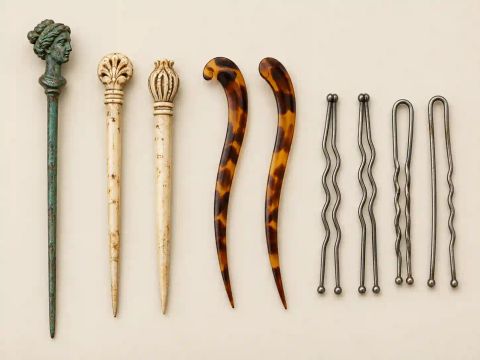
Almost every dressed style in this site’s history — the bun, the pompadour, pin curls, victory rolls — depends on pins. They are among the most ordinary and most frequently lost objects in any household, which is exactly why they matter.
Pins as ornament
Ancient pins could be both functional and decorative. The Science Museum Group holds a 124-millimetre Roman bronze hairpin with a boy’s head at its tip, dated broadly between 199 BCE and 500 CE.[1] Evidence status: Verified Pins like this show that a hairstyle could carry decoration, and perhaps wealth, in the tools that held it together.
Pins as mass production
Evidence status: Research In the nineteenth and twentieth centuries, cheap wire pins and sprung grips made complex styles possible for people without servants or hairdressers. When these reached British shops, and at what price, still needs checking against manufacturers’ catalogues.
Names
In Britain a sprung pin is often a kirby grip; in North America, a bobby pin. “Bobby pin” is recorded from 1928, from the bobbed hair it held.[2] Evidence status: Verified Evidence status: Research “Kirby grip” is said to come from Kirbigrip, a trade mark of the Birmingham pin makers Kirby, Beard & Co., recorded from 1926; we still need to check this against the dictionary entry itself.
Why pins matter to this history
Evidence status: Interpretation Pins are a reminder that most historical hairstyles were constructions, not simply hair that grew a certain way. A dressed style that looked effortless might hold dozens of pins, and the skill of placing them was learned — often from a mother, sister or friend.
Object story
- What is it made of, and how does it work?
- A single shaft or a folded wire. Straight pins hold coils and buns in place; folded, sprung pins and grips clamp hair flat against the head.
- Who made and sold it?
- Not yet researched.
- Who used it — at home, in the salon, at work?
- Nearly everyone who dressed their hair up. Pins were used by wearers themselves, by family members and by hairdressers.
- What signs of use should we look for?
- Bent and opened pins, lost decorative heads, and chipped coatings on later steel grips.
- Where can dated examples be seen?
- The Science Museum Group’s Roman bronze hairpin (199 BCE–500 CE) is one dated example; many more survive as archaeological finds.
Used for
-
Technique · Temporary setting
Finger waving
Shaping wet hair with fingers and a comb into rippling S-shaped ridges — the signature set of the late 1920s and 1930s, and a test of skill.
-
Technique · Temporary setting
Roller setting
Winding damp hair on rollers and drying it in place — the engine of the weekly "shampoo and set" and of mid-century volume.
Sources
- Science Museum Group, “Hairpin, bronze, decorated with boy’s head, Roman (A624626)”. Accessed 25 September 2026. What it shows: A 124 mm bronze pin with a decorative head, dated broadly 199 BCE–500 CE.
- Douglas Harper, “bobby pin (n.)”, Online Etymology Dictionary. Accessed 25 September 2026. What it shows: Dates "bobby pin" to 1928, from "bob" (short hair) + "pin".
Further reading
- Caroline Cox, Good Hair Days: A History of British Hairstyling, Quartet Books, 1999. details to check A general history of British hairdressing and styles.