Style
Victory rolls
Hair rolled high at the front and pinned — the style most people now picture for the 1940s, and one of the most revived.
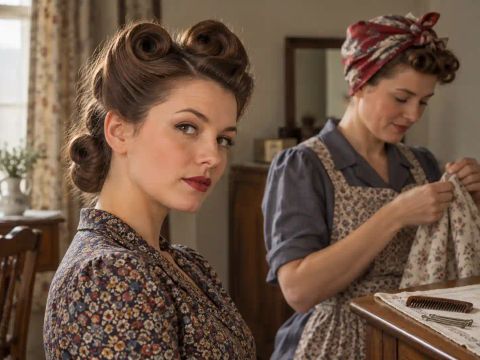
Victory rolls are sections of set hair rolled — usually upwards and back from the face — and pinned into smooth tubes, often on each side of a parting. They are now the style most people picture for the 1940s.
Form and construction
The Imperial War Museums’ modern guide to recreating the look describes hair set overnight with rollers and setting lotion and wrapped in a headscarf; the next day the front is rolled and pinned into “the iconic victory roll”, while the back can be rolled at the nape over a pad or ratA pad or cushion, often made from the wearer’s own saved combings, placed under the hair to give it volume or height. Used under eighteenth-century dressed hair, Victorian and Edwardian styles, and 1940s rolls..[1] Evidence status: Verified That is a recreation, not a wartime source — but it shows the dependence of the style on an earlier set and on pins.
A hairstylist in the same guide suggests that women doing their own hair would have had “a little bit of frizz and a little bit of mess” rather than salon perfection.[1] Evidence status: Interpretation
Work, war and image
Evidence status: Interpretation Rolled styles kept hair up and away from the face, which suited work. But the tidiest images of wartime women are not neutral evidence. The Imperial War Museums’ reading of the 1943 painting of the factory worker Ruby Loftus describes it as an idealised image, her hair “safely covered and pulled back”.[2] Headscarves and turbans were an everyday alternative, and the museum notes a wartime trend for “trousers and turbans”.[2] Evidence status: Verified
The name
Age and life stage
Evidence status: Research The style is usually shown on young adult women. How older women and schoolgirls wore rolled styles during the war is not yet documented here, and still needs checking against photographs.
Revivals
Victory rolls are a staple of vintage and rockabilly fashion and of 1940s re-enactment. Evidence status: Interpretation Revivals tend to reproduce the silhouette with modern products; they often lose the everyday imperfection that the Imperial War Museums’ guide describes.
How was it made?
-
Technique · Temporary setting
Roller setting
Winding damp hair on rollers and drying it in place — the engine of the weekly "shampoo and set" and of mid-century volume.
-
Object · Ancient to present
The hairpin
The small, easily lost tool that holds up almost every dressed style in history — from decorated Roman bronze to the mass-produced wire grip.
-
Object · Prehistoric to present
The comb
The most ordinary hair tool, and one of the most revealing — from ancient carved combs to celluloid dressing-table sets, wide-toothed picks and heated pressing combs.
Sources
- Imperial War Museums, “1940s fashion: how to get the look”. Accessed 25 September 2026. What it shows: A modern recreation (not a primary source) of 1940s setting — rollers and setting lotion overnight, a headscarf, victory rolls at the front and a roll at the nape over a “rat”.
- L. Clouting, “Fashion on the Ration: 1940s Street Style”, IWM blog, Imperial War Museums, 14 May 2015. Accessed 25 September 2026. What it shows: Notes a wartime trend for trousers and turbans, and describes the 1943 painting of the factory worker Ruby Loftus as idealised, her hair “safely covered and pulled back”.
- The Argus (Melbourne), “[Report on the ‘Victory Roll’ hair style]”, 1 August 1941. Accessed 25 September 2026. details to check What it shows: Quoted in several secondary histories as the earliest dated use of “Victory Roll” for a hairstyle, “inspired by the V for Victory campaign”. Headline and wording still to be checked against the scan.
Further reading
- Caroline Cox, Good Hair Days: A History of British Hairstyling, Quartet Books, 1999. details to check A general history of British hairdressing and styles.