Style
The bun and chignon
Hair gathered, coiled and pinned — a form that has meant imperial elegance, respectable adulthood, workplace safety and, lately, deliberate messiness.
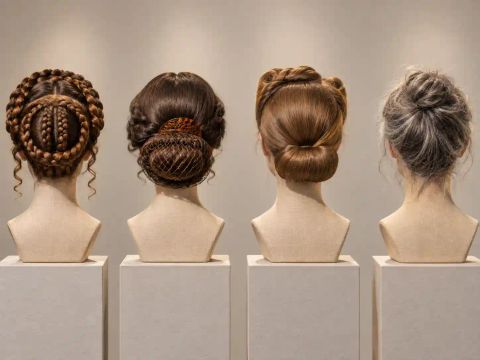
A bun is hair gathered at the crown, back or nape and coiled, knotted or rolled into place. It depends on small, easily lost tools — pins — and often on additions: switchesA length of real or synthetic hair, gathered at one end, added to the wearer’s own hair to make braids, coils or buns fuller. of extra hair, or pads called ratsA pad or cushion, often made from the wearer’s own saved combings, placed under the hair to give it volume or height. Used under eighteenth-century dressed hair, Victorian and Edwardian styles, and 1940s rolls. to give it bulk.
Form and construction
The basic sequence is simple: gather, twist or braid, coil, pin. What changes over time is where the bun sits, how smooth it is, how much hair is added, and what surrounds it — fringes, side curls, nets, combs, caps or veils.
Documented wearers
Roman imperial portrait sculpture records elaborate ringlets, rolls and looped braids gathered at the back of the head, changing quickly between reigns. But sculpture shows ideals and official images, not an average morning routine.[1] Evidence status: Verified
- Regency Britain: centre partings with face-framing curls and braided or coiled buns. Evidence status: Research The details come from fashion plates and portraits, which need checking against surviving hair ornaments and accounts of ordinary dress.
- Victorian Britain: back hair grew larger over the century, supported by nets, pads and false plaits. Evidence status: Research We will not call any one silhouette “Victorian hair”; the period page will set out dated changes once the evidence has been checked.
- Wartime: practical rolls, pinned buns and snoods kept hair away from machinery. Evidence status: Research How far this was enforced rule rather than advice needs checking in workplace records.
Age and life stage
Evidence status: Interpretation For much of the nineteenth and early twentieth centuries in Britain, putting one’s hair up marked the passage from girlhood to adulthood, just as lengthening skirts did. Evidence status: Research The age at which this happened, and how it varied with class and work, still needs primary evidence to confirm.
Older women’s buns are often described in sources as old-fashioned or “sensible”. We want to record them instead as long-practised technique and choice. For girls, the tightly pinned ballet bun is a school-age form with its own rules.
Meanings
A bun can signal respectability, maturity, discipline, faith, safety or practicality — or, in its “messy” modern form, a studied ease. Evidence status: Interpretation Effortless-looking styles often conceal labour: a loose bun that looks casual can take practice, products and time.
Safety
How was it made?
-
Object · Prehistoric to present
The comb
The most ordinary hair tool, and one of the most revealing — from ancient carved combs to celluloid dressing-table sets, wide-toothed picks and heated pressing combs.
Sources
- Paul Zanker, Roman Portraits: Sculptures in Stone and Bronze in the Collection of The Metropolitan Museum of Art, Metropolitan Museum of Art, 2016. Accessed 25 September 2026. What it shows: Catalogue of Roman portrait sculpture; hairstyle fashions spread from the imperial family with its portraits. Sculpture shows official and elite ideals, not everyday routines.
- British Association of Dermatologists, “Traction alopecia”, produced February 2019. Accessed 25 September 2026. What it shows: Patient information leaflet. Names tight ponytails, buns, braids, weaves and extensions, clips and tight head scarves; risk rises when combined with chemical relaxers. The leaflet’s own review date (February 2022) has passed.
Further reading
- Caroline Cox, Good Hair Days: A History of British Hairstyling, Quartet Books, 1999. details to check A general history of British hairdressing and styles.