c. 500–1500
Veils, braids and combs
Covered and uncovered hair in medieval Britain, Ireland and western Europe — combs from early medieval settlements and graves, veils, wimples and nets in manuscripts, girls' loose hair and religious rules — and the myth that every woman covered every strand.
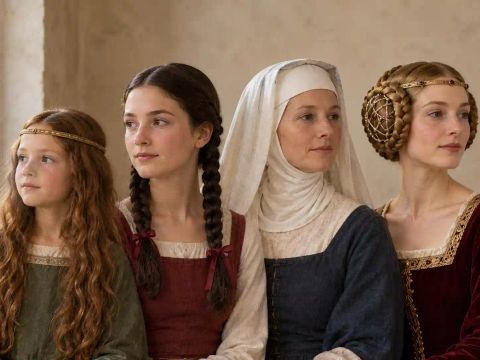
A thousand years, many kingdoms, several faiths: there was no single “medieval hairstyle”. This essay concentrates on Britain and Ireland, using western European manuscripts where British evidence is still to be checked, and says plainly where that borrowing leaves gaps. Much of the surviving evidence comes from two very different places — combs from the ground, and images painted for wealthy readers.
Early medieval Britain and Ireland: combs from the ground
The most common direct evidence for hair care in early medieval Britain and Ireland is the comb. The archaeologist Steve Ashby notes that “bone and antler hair combs are among the early medieval period’s most frequently recovered artefacts, both from settlement and funerary contexts”, and that, as hygiene implements of low value, they were unlikely to be kept as heirlooms.[1] Evidence status: Verified Many were composite combs, made of several plates riveted together, some single-sided and some double-sided; ornate, high-backed composite combs, dated by earlier specialists to the fifth to eighth centuries, “are well known in Ireland and Scotland”.[1] Evidence status: Verified See the comb.
Evidence status: Interpretation A comb that was ordinary, cheap and everywhere is exactly what a history of everyday hair needs. Combs were also health tools: fine teeth remove lice, a job that has always fallen heavily on those who care for children.
Evidence status: Research We have not yet checked grave evidence for Anglo-Saxon women’s hair pins and head coverings, or Anglo-Saxon and early Irish manuscript images of women, and will not describe early medieval women’s styles until we have. Which combs belonged to women, men or children is also still to check: a comb in a grave does not tell us whose hair it was used on.
Covered and uncovered hair
In later medieval western European art, covering is strongly associated with adult status. A Getty Museum feature, drawing mainly on French and Italian manuscripts of about 1280–1500, states that “usually only young, unmarried women wore their hair uncovered and loose”, and that “it was more common for modest ladies to wear their hair braided, plaited away from the face, and covered with a veil, hat, hairnet, or wimple”.[2] Evidence status: Verified The same feature notes that styles “were highly dependent on time, place, and social status”.[2] Evidence status: Verified
Girls, marriage and age
In a Getty Visitation miniature of about 1480–85, “the relative ages of the women are communicated through their hair”: the younger Mary’s hair “falls down her back, while her older cousin, Elizabeth, wears a covering”.[2] Evidence status: Verified
Evidence status: Interpretation Loose hair in this visual language marks youth and maidenhood; covering marks marriage and maturity. That makes hair a way of reading a woman’s life stage at a glance — but it is a painter’s code for sacred figures, not a census of how girls in English villages wore their hair.
Evidence status: Research We still need British evidence for everyday practice: whether working girls wore their hair loose, braided or tied back; when a girl was expected to begin covering; and regional exceptions in Wales, Scotland and Ireland. We have not yet found sources that let us say how older women’s hair changed — greying, thinning — or how it was treated.
Religious life
Rules about hair were part of religious discipline for some women. Ancrene Wisse, an early thirteenth-century English guide for anchoresses (religious women who lived enclosed, apart from the world), survives in several manuscripts; its earliest surviving copy is British Library Cotton MS Cleopatra C VI (about 1225–30). According to the British Library’s summary, it instructs that anchoresses have their hair “cut, shaved or trimmed four times a year”, and wear a wimple or a simple cap.[3] Evidence status: Verified Many monks and clerics wore the tonsure, shaving part of the head as a sign of entry into the clergy.[2] Evidence status: Verified
Evidence status: Interpretation For an anchoress, hair was not an ornament to be dressed but something to be kept short and covered — an unusual rule for an unusual life, written for a handful of women, not a guide to lay practice.
Christian, Jewish and Muslim communities in and beyond medieval Europe had their own, internally varied, teachings and customs about women’s hair and covering, which changed by place, period, age and observance. We will not reduce them to one rule. Those pages will be written with faith-literate advisers.
Washing and care
The Getty feature states that before shampoo, hair was washed with water and, “for the more well-off, a mixture of ashes and egg whites was used, along with herbs and flowers”.[2] Evidence status: Verified Evidence status: Research The feature does not name its primary source; we still need to find the medieval recipe texts behind this, and whether they were used in Britain. This is history, not a recipe to try.
Hair textures
Evidence status: Research Medieval images and texts from Britain rarely describe hair texture and we have not yet found sources about women with curly or coily hair in medieval Britain. The scope of this essay is therefore narrower than we would like.
Africa, Asia and the Islamic world
Hair and headwear across medieval Africa, Asia and the Islamic world will be covered in separate specialist essays, written from local art, texts and archaeology — not reconstructed from European travellers’ descriptions. Until they are written we make no claims about those regions here.
Styles, techniques and people from this period
-
Object · Prehistoric to present
The comb
The most ordinary hair tool, and one of the most revealing — from ancient carved combs to celluloid dressing-table sets, wide-toothed picks and heated pressing combs.
Sources
- Steve Ashby, “Bone and Antler Combs”, Datasheets of the Finds Research Group AD700–1700, Datasheet 40, 2007. Accessed 25 September 2026. What it shows: Typology of early medieval composite combs in the British Isles; states that bone and antler hair combs are among the period's most frequently recovered artefacts, from settlements and graves, and that ornate high-backed composite combs are well known in Ireland and Scotland.
- Larisa Grollemond and Sarah Waldorf, “Did Medieval People Use Shampoo?”, Getty News, J. Paul Getty Trust, 10 May 2023. Accessed 25 September 2026. What it shows: Short museum feature using mainly French and Italian manuscripts of c. 1280–1500; states that usually only young, unmarried women wore hair uncovered and loose, and that braided hair covered with a veil, hat, hairnet or wimple was more common; shows age signalled by hair in a Visitation miniature.
- Calum Cockburn, “Keeping a cat and other rules for anchoresses”, British Library blogs (Medieval manuscripts), British Library, 29 October 2024. Accessed 25 September 2026. What it shows: Describes Cotton MS Cleopatra C VI (c. 1225–30) as the earliest surviving manuscript of Ancrene Wisse. On Ancrene Wisse (early 13th century; British Library Cotton MS Cleopatra C VI); summarises its rules that anchoresses have their hair cut, shaved or trimmed four times a year and wear a wimple or simple cap.
Further reading
- Steven P. Ashby, “An Atlas of Medieval Combs from Northern Europe”, Internet Archaeology 30, 2011. Accessed 25 September 2026. Open-access reference atlas of early medieval bone and antler hair combs across northern Europe and the British Isles, for dating and comparing finds.