1837–1900
Loops, nets and fringes
Six decades of changing shapes — smooth centre parts and side loops, netted chignons, false plaits and curled fringes — built with pins, pads and bought hair, some of it harvested from poorer women.
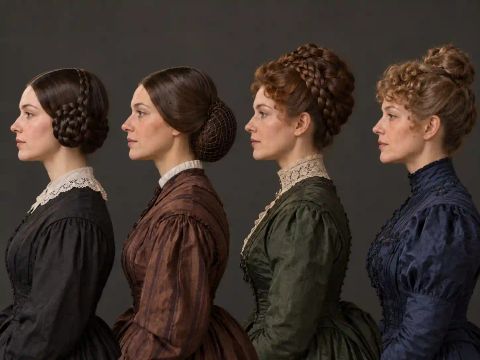
There was no single “Victorian hair”. Between 1837 and 1900 fashionable shapes changed roughly every decade, and hair was built as much from pins, nets, pads and bought hair as from the wearer’s own. Most of the dated evidence below describes fashionable European and American dress; how far each shape reached working women in Britain, and at what ages, is a question we mark as open.
Changing silhouettes
- 1840s: in the Fashion History Timeline (published by the Fashion Institute of Technology), women’s hair was “parted in the center, and looped smoothly over the ears, drawn back into a chignon or bun”, with long ringlets beside the face as an alternative, especially for younger women on dressier occasions.[1] Evidence status: Verified
- 1860s: early in the decade, hair was centre-parted and combed smoothly back into a chignonHair gathered and coiled, knotted or rolled at the back of the head or nape., often held in a netA net or knitted bag holding hair at the back of the head. Worn in many periods; associated in Britain with wartime work and safety. of chenille or silk. Later, arrangements grew larger, with loose curls behind, and false hair was sold ready-made as puffs, curls and braids.[2] Evidence status: Verified
- 1870s: hair was piled into knots and braids with curls falling down the back, and “false hair was generally worn”. By the end of the decade it was drawn into high, tight chignons; “Sometimes, a short curly fringe was cut in the front.” The survey associates the tight chignon and curled fringe with Alexandra, Princess of Wales.[3] Evidence status: Verified
- 1880s–1890s: curls were tucked up into tight chignons, which the survey links to the high collars of the mid-1880s, while hats perched on top of the head grew tall; by the 1890s the survey describes high, neat chignons with soft curls at the front.[4][5] Evidence status: Verified
Evidence status: Interpretation Association is not invention: a princess wearing a fringe made it visible and respectable, but it does not show she started it. Evidence status: Research We still need British fashion plates, dated photographs and hairdressers’ manuals to check how closely these decade labels fit Britain, and how quickly they reached provincial towns. See also the bun.
Bought hair and who supplied it
Larger arrangements needed more hair than most heads grew. Plaits and switchesA length of real or synthetic hair, gathered at one end, added to the wearer’s own hair to make braids, coils or buns fuller. were made from human hair bought and sold internationally. Emma Tarlo quotes Thomas Adolphus Trollope, describing a fair at Collinée in Brittany during his 1839 tour (published in 1840 as A Summer in Brittany): “We saw several girls sheared one after the other like sheep, and as many more standing ready for the shears, with their caps in their hands, and their long hair combed out and hanging down to their waists.”[9][10] Evidence status: Verified (Tarlo dates the visit to 1840, the year the book was published; Trollope’s own introduction places it in the summer of 1839.)
Tarlo also quotes an 1875 account of the London Hair Market at Mincing Lane, which ranked hair by origin: most of the stock, it said, came from China, while one bale of “choice European” hair was worth ten or eleven times as much. She notes that much Chinese export hair was combings from men’s queues, and that in Britain the cropping of inmates’ hair in prisons, workhouses and hospitals, useful to the trade, was no longer compulsory by the 1850s.[9] Evidence status: Verified
Evidence status: Interpretation A fashionable chignon could therefore rest on the hair of poor girls, institutional inmates and distant sellers, priced on a scale that tied value to race and origin. We reproduce none of the period’s racialised advertising images here. Evidence status: Research How British newspaper advertisements for hair products used imperial and racialised imagery is still to be researched from dated examples, and we have not yet checked mail-order hairpiece catalogues.
Pins, brushes, restorers and dryers
Evidence status: Research Mass-produced wire hairpins, brushes and combs were probably cheaper and more widely owned by the end of the century than at its start. This still needs checking against dated Birmingham manufacturers’ records, catalogues and prices (see the hairpin and the comb).
Branded products were sold to people worried about thinning hair. The Science Museum Group holds a box for “Tyne” Hair Restorer, made by R. Cubey, a chemist in Blaydon-on-Tyne, dated 1890–1915; a bottle cost a shilling and the box shows a woman with full hair.[11] Evidence status: Verified Drying took time as well as effort: the stoneware “Thermicon”, made in London in 1880–1900, was filled with boiling water and brushed through the hair.[12] Evidence status: Verified (See the hair dryer and grey hair, hair loss and wigs.)
Evidence status: Research Studio photography, especially the cheap card portrait, made hairstyles easy to compare and copy from mid-century. We have not yet found a dated museum source setting out how photographs were used by sitters or hairdressers.
Loose hair in art
Evidence status: Interpretation If putting hair up marked the move into adulthood (see the age section below), loose hair on a grown woman carried meaning. Tate notes that Elizabeth Siddal and Jane Morris designed their own clothes, did not wear traditional corsets and “left their long hair loose”.[6] Evidence status: Verified
Evidence status: Interpretation Unbound hair in paintings was a sign — of intimacy, legend or unconventionality — not a record of how most women went out. A painting tells us what an artist wanted hair to mean; it should not be read as a street photograph.
Hair work and mourning
Hair was kept as well as worn. The V&A notes that much Victorian mourning jewellery contained the hair of the dead, made by specialist “hair artists”, and that hair jewellery was also made as keepsakes “of love and friendship”.[7] Evidence status: Verified One example is an English mourning bracelet of about 1846: a band of woven human hair with a gold clasp commemorating Josiah Wedgwood II (died 1843, aged 74) and his wife Elizabeth (died 1846, aged 82), with an inset of hair that may combine both of theirs.[8] Evidence status: Verified
Evidence status: Interpretation Hair from an older woman, woven by a craft worker and worn by a relative, links three kinds of life that fashion history usually separates: age, labour and grief.
Age
The Fashion History Timeline describes a threshold: “Between the ages of fourteen and sixteen, a girl’s hem would drop to the floor, and her hair would be pulled back into adult styles”. In the 1860s it describes young girls with hair “in curls”, and in the 1870s girls wearing long curled hair, sometimes with a fringe.[1][2][3] Evidence status: Verified Long curls were not only for girls: the 1890s survey notes long curls on small boys dressed in “Fauntleroy” suits.[5] Evidence status: Verified
Evidence status: Research Ribbons, plaits and ringlets appear in many studio portraits of girls, but those images were arranged by adults for an occasion. Girls who were already at work in mills, service or shops by their early teens will have met workplace rules, not fashion plates; we have not yet found records that show what those rules were. Older women’s caps and simpler dressed hair also need their own dated sources.
Styles, techniques and people from this period
-
Object · Prehistoric to present
The comb
The most ordinary hair tool, and one of the most revealing — from ancient carved combs to celluloid dressing-table sets, wide-toothed picks and heated pressing combs.
-
Object · c. 1575 BCE to present
Curling tongs and the Marcel iron
Heated metal pincers for curling and waving hair — a tool with a history of more than three thousand years, from Egyptian bronze to the salon Marcel iron.
-
Object · 1880s to present in British collections
The hair dryer
From a stoneware bottle of boiling water to the row of humming salon hoods — how drying, the slowest part of every set, was turned into a machine.
-
Object · Ancient to present
The hairpin
The small, easily lost tool that holds up almost every dressed style in history — from decorated Roman bronze to the mass-produced wire grip.
-
1852–1936
Marcel Grateau
The Paris hairdresser whose name became the Marcel wave — a heated-iron wave worn for half a century. The technique’s fame is well documented; much of his life, and the patents often credited to him, are not.
-
Essay
How trends travel
From engraved coiffure plates to TikTok, each new medium changed how fast a hairstyle could be seen. This essay follows the channels (prints, photographs, film, fan magazines, trade journals, television and platforms) and asks what evidence could ever show that a famous head caused many others to follow.
-
Essay
Rules about hair
Prisons, poorhouses, hospitals, kitchens, factories, schools and the army have all written rules about women’s and girls’ hair. This essay compares what the rules said with how they were enforced, separates genuine task-specific safety from demands for a particular look, and asks whose natural hair was treated as the problem — mainly in Britain, from the 1840s to today.
-
Essay
Heat, electricity and chemistry
Taps, shampoo, tongs, dryers, perm machines, relaxers, synthetic dyes, plastics and fibres all changed what could be done with hair. This essay asks what each one cost in time, labour and money — and who could afford it — mainly in Britain, with American comparison.
-
Style · Braided, twisted or locked
Braids and plaits
One of the oldest ways of dressing hair — and not one style but many, from a school plait tied with a ribbon to cornrows, box braids and ancient braided wigs.
-
Style · Dressed style
The bun and chignon
Hair gathered, coiled and pinned — a form that has meant imperial elegance, respectable adulthood, workplace safety and, lately, deliberate messiness.
-
Style · Addition or covering
Wigs and hairpieces
Added hair is part of hair culture, not "fake hair" — from ancient plaited wigs to Victorian switches, 1960s fashion wigs, extensions and wigs worn through illness.
-
Technique · Temporary setting
Marcel waving
A deep, regular wave made with heated irons — a salon skill that shaped late-Victorian, Edwardian and 1920s hair, and a staple of Black beauty culture.
Sources
- Harper Franklin; Fashion Institute of Technology (SUNY), Fashion History Timeline, “1840-1849”, Fashion History Timeline. Accessed 25 September 2026. What it shows: University-published decade survey (European and American dress). Centre-parted hair looped smoothly over the ears into a chignon or bun; ringlets for younger women on dressier occasions; girls’ hair pulled back into adult styles between fourteen and sixteen.
- Harper Franklin; Fashion Institute of Technology (SUNY), Fashion History Timeline, “1860-1869”, Fashion History Timeline. Accessed 25 September 2026. What it shows: Early-1860s centre parts and smooth chignons in chenille or silk nets; late-decade larger arrangements with loose curls; false hair sold as puffs, curls and braids; girls’ hair “in curls”.
- Harper Franklin; Fashion Institute of Technology (SUNY), Fashion History Timeline, “1870-1879”, Fashion History Timeline. Accessed 25 September 2026. What it shows: Piled knots and braids with cascading curls; “false hair was generally worn”; by the end of the decade high, tight chignons and sometimes a short curly fringe, associated with Alexandra, Princess of Wales; girls’ long curled hair, sometimes with a fringe.
- Harper Franklin; Fashion Institute of Technology (SUNY), Fashion History Timeline, “1880-1889”, Fashion History Timeline. Accessed 25 September 2026. What it shows: The cascading curls of the 1870s tucked up into tight chignons; tall, narrow hats.
- Harper Franklin; Fashion Institute of Technology (SUNY), Fashion History Timeline, “1890-1899”, Fashion History Timeline. Accessed 25 September 2026. What it shows: High, neat chignons with soft curls at the front; long curls on boys dressed in “Fauntleroy” suits.
- Tate, “The art, life and love of the Rossettis”, The Rossettis (Tate Britain exhibition, to 24 September 2023). Accessed 25 September 2026. What it shows: States that Elizabeth Siddal and Jane Morris designed their own outfits, did not wear traditional corsets and “left their long hair loose”.
- Mona Choo, “Hair”, V&A Blog, Victoria and Albert Museum, 25 June 2009. Accessed 25 September 2026. What it shows: Victorian mourning jewellery containing the hair of the dead; specialist “hair artists”; hair jewellery also made as keepsakes of love and friendship.
- Victoria and Albert Museum, “Mourning bracelet (WE.4293-2014)”, ca. 1846. Accessed 25 September 2026. What it shows: English band of woven human hair with a gold clasp, commemorating Josiah Wedgwood II (d. 1843) and Elizabeth Wedgwood (d. 1846, aged 82); the inset hair is possibly a mixture of both.
- Emma Tarlo, “The Secret History of Buying and Selling Hair”, Smithsonian Magazine, 14 November 2016. Accessed 25 September 2026. What it shows: Excerpt from Tarlo’s Entanglement. Quotes T. A. Trollope (1840) on girls’ hair bought at Breton fairs, an 1875 account of the London Hair Market at Mincing Lane ranking Chinese against European hair, and notes that cropping of inmates’ hair in British prisons, workhouses and hospitals was no longer compulsory by the 1850s.
- Thomas Adolphus Trollope, “A Summer in Brittany, vol. I”, Henry Colburn, 1840. Accessed 26 September 2026. What it shows: Chapter XVIII (pp. 322–23) describes girls’ hair being cut and sold at the fair at Collinée; the introduction dates the tour to the summer of 1839.
- Science Museum Group, “Box for the ‘Tyne’ Hair Restorer, England, 1890-1915 (1988-1405/1)”. Accessed 25 September 2026. What it shows: Made by R. Cubey, chemist, of Blaydon-on-Tyne; sold at one shilling a bottle to stimulate weak hair and replace lost hair; the box shows a woman with full hair.
- Science Museum Group, “Stoneware hair dryer, ‘Thermicon’, London, England, 1880–1900 (A650887/2)”. Accessed 25 September 2026. What it shows: Made by Hincks & Co., London. Filled with boiling water and brushed through the hair; from the 1920s such dryers were gradually replaced by electrical devices.
Further reading
- Emma Tarlo, Entanglement: The Secret Lives of Hair, Oneworld, 2016. details to check An anthropology of the global trade in human hair, wigs and extensions, and of hair loss.
- Caroline Cox, Good Hair Days: A History of British Hairstyling, Quartet Books, 1999. details to check A general history of British hairdressing and styles.
- Geraldine Biddle-Perry and Sarah Cheang (eds), Hair: Styling, Culture and Fashion, Berg, 2008. details to check Cross-cultural essays on hair in fashion, film, art, history and consumer culture.