
1789–1836
Revolution and Regency
Between the French Revolution and the 1830s, powder and height gave way to crops, classical curls, centre partings, knots and turbans — though “natural-looking” hair still took cutting, curling, pins and often false hair, and locks of hair were set into jewels for love, friendship and mourning.
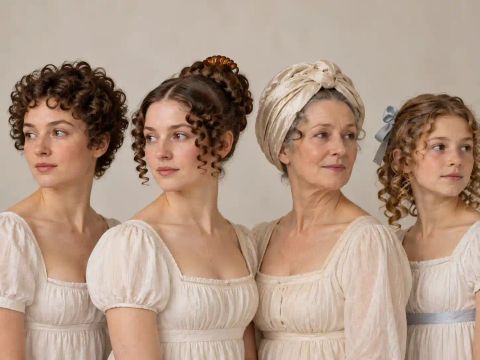
In little more than a decade, fashionable hair in Paris and London changed from powdered height to short curls and simple-looking knots. This page follows that change without taking “natural” at face value: the new styles were named after ancient Rome, relied on hairdressers and wigs, and were shaped by war, tax and empire.
After the Revolution: crops and classical names
Evidence status: Verified The Fashion History Timeline describes the 1790s in France as bringing unpowdered curls and a “rage for short hair and short-haired wigs”. Josephine du Pont, writing on her return to France in 1798, reported Titus hairstyles for men and women as “extremely convenient, especially when we have a wig for the sake of variety”, and praised “little blond wigs”; a fashion editor of the time reported women changing hair colour daily, as they changed their gowns.[1]
Around 1800, hairstyles were given names from antiquity such as à l’Agrippine; the most extreme, à la Titus, was cropped short and tousled, while more often hair was arranged in ringlets and curls with bandeaux, ribbons and jewelled combs.[2] Evidence status: Verified Louis-Sébastien Mercier’s description of Parisian public balls in the 1790s, quoted in translation by the Fashion History Timeline, pictured dancers with “their hair turned in tresses around their heads by modish hairdressers, who study the antique busts”.[1] Evidence status: Verified
Evidence status: Interpretation The classical look was a fashion built from sculpture and imagination, not a return to how hair “naturally” fell. Cropping needed a skilled cut; curls needed setting; and wigs let a woman wear the crop without cutting her own hair. See also curling tongs. Evidence status: Research How widely women in Britain, rather than Paris, actually cropped their hair is still to be checked against British portraits, letters and magazines.
Powder taxed
Evidence status: Verified In 1795, under William Pitt, Britain imposed a tax on hair powder, which the Lewis Walpole Library suggests probably contributed to the growing popularity of unpowdered hair at the end of the century.[5] Warwickshire County Record Office explains that users had to obtain a certificate carrying a stamp duty of one guinea; its surviving returns for 1795 and 1796 list names, parishes and household roles, including servants, and the tax was not repealed until 1869.[6]
Printmakers seized on it. A satire published by S. W. Fores in June 1795, now at the London Museum, shows a chimney sweep with white-powdered hair: “Licenc’d to wear hair powder!!”.[7] Evidence status: Verified Evidence status: Interpretation The joke is about who was entitled to a mark of rank once it could be bought for a guinea. Evidence status: Research We have not yet read the act itself, and still need to check how many women — mistresses and maidservants — appear in surviving certificate lists.
Regency partings, knots and false hair
Evidence status: Verified In the 1810s, according to the Fashion History Timeline, hair was usually parted in the centre, with ringlets hanging at the front and curls arranged at the back; cropped styles were still sometimes seen early in the decade.[3] By the mid-1820s evening styles had grown tall again: the Apollo knot raised loops of hair from the crown, with sausage curls at the temples, and the late-1820s style à la Chinoise combined plaits and knots held with long decorative pins.[4] Evidence status: Verified See the bun, the comb and the hairpin.
False hair did not vanish. Richard Newton’s print Wigs All the Rage (1798) shows men and women holding up wigs that imitate natural hair, and James Gillray’s Progress of the Toilet. The Wig (1810) shows a maid readying her mistress’s wig.[5] Evidence status: Verified Evidence status: Interpretation Both are satires, but they suggest that wigs and hairpieces were a familiar part of the “natural” look. Evidence status: Research The Apollo knot is often said to have used false loops; we have not yet found a dated source to confirm how commonly it did.
Turbans, shawls and Orientalism
Evidence status: Verified The Fashion History Timeline links the fashion for evening turbans to Napoleon’s occupation of Egypt, and calls the Indian cashmere shawl the most important accessory of the neoclassical period.[2] Turbans remained stylish evening wear into the 1810s.[3] In 1800 the Irish writer Melisina Trench described Emma Hamilton making “a variety of turbans” from Indian shawls in her performances.[1] Evidence status: Verified
Evidence status: Interpretation This was Orientalism: European women put on an imagined “East” as costume, while war and the East India trade secured the textiles. The turban was borrowed as a fashionable shape, detached from the people for whom head-wrapping carried religious, regional or social meaning; those meanings will be written about with faith-literate advisers rather than generalised here. Evidence status: Research The colonial supply of other hair goods — tortoiseshell combs, oils, and human hair for pieces — still needs sourcing.
Hair jewellery and remembrance
Evidence status: Verified The V&A notes that jewels enclosing hair circulated in England from the seventeenth century and became widespread through the eighteenth, affordable in rings, slides, lockets and pendants to people of modest means.[9] Wills often left money for mourning rings; later-eighteenth-century rings took neo-classical funerary designs — urns, pillars, mourning figures — with the dead person’s hair worked into the design or set behind it. A black-enamelled gold London ring of 1810–11 shows an urn with plaited hair under a crystal, among anchors and sea horses.[8]
Not every piece was for mourning. A V&A blog post notes that hair jewellery was also used as a keepsake of love and friendship.[10] Evidence status: Verified A pendant holding the hair of Frances Fisher, who died in 1802 aged 53, may have begun as a sentimental gift and been turned into a memorial later.[9] Evidence status: Verified
Evidence status: Interpretation The categories are useful but not fixed. Inscriptions with death dates, funerary imagery and black enamel point to mourning; initials, hearts or friendship mottoes point to affection; but one lock could move from one meaning to the other. Evidence status: Research We still need dated, securely identified examples of courtship pieces, and of hairwork done at home rather than by jewellers.
Age and life stage
Evidence status: Verified Du Pont claimed that the little blond wigs of 1798 took “ten years off the age of the wearer”.[1] Through the 1810s and 1820s, white day caps were worn indoors by married or older women.[3][4] In mourning rings, the V&A notes, white enamel was often, though not always, used for children and unmarried people.[8] Evidence status: Research Girls’ everyday hair in this period — short crops, plaits, or curls — is not yet documented here, and needs checking against portraits of children and school records.
What this page cannot yet show
Evidence status: Research Our sources describe fashionable, mostly white women in Paris and London with straight, wavy or curly hair. We have not yet found sources for how women of African and Asian descent in Regency Britain wore their hair, or for Irish, Scottish and Welsh practice beyond the capitals. These are gaps to fill, not absences.
Styles, techniques and people from this period
-
Essay
How trends travel
From engraved coiffure plates to TikTok, each new medium changed how fast a hairstyle could be seen. This essay follows the channels (prints, photographs, film, fan magazines, trade journals, television and platforms) and asks what evidence could ever show that a famous head caused many others to follow.
-
Style · Dressed style
The bun and chignon
Hair gathered, coiled and pinned — a form that has meant imperial elegance, respectable adulthood, workplace safety and, lately, deliberate messiness.
Sources
- Michele Majer, “1790-1799”, Fashion History Timeline, Fashion Institute of Technology (SUNY), 1 August 2017; updated 31 January 2022. Accessed 25 September 2026. What it shows: Unpowdered curls, short hair “à la Titus” and short-haired and blond wigs in France in the later 1790s, quoting Josephine du Pont’s letters (via Low); Emma Hamilton’s turbans made from Indian shawls.
- Harper Franklin, “1800-1809”, Fashion History Timeline, Fashion Institute of Technology (SUNY), 25 June 2020; updated 25 November 2025. Accessed 25 September 2026. What it shows: Classical names for hairstyles, the cropped “à la Titus”, ringlets with bandeaux, ribbons and jewelled combs, evening turbans linked to Napoleon’s occupation of Egypt, and Indian cashmere shawls.
- Harper Franklin, “1810-1819”, Fashion History Timeline, Fashion Institute of Technology (SUNY), 1 June 2020; updated 25 November 2025. Accessed 25 September 2026. What it shows: Centre-parted hair with front ringlets and curls at the back; crops still sometimes seen early in the decade; day caps for married or older women; evening turbans.
- Harper Franklin, “1820-1829”, Fashion History Timeline, Fashion Institute of Technology (SUNY), 27 May 2020; updated 25 November 2025. Accessed 25 September 2026. What it shows: Tall evening hairstyles by the mid-1820s, the Apollo knot and “à la Chinoise” plaits and knots with long pins; day caps for married or older women.
- Lewis Walpole Library, Yale University, “Preposterous Headdresses and Feathered Ladies: Hair, Wigs, Barbers, and Hairdressers”, Lewis Walpole Library, 2003 (exhibition 8 May – 29 October 2003). Accessed 25 September 2026. What it shows: Exhibition checklist of British satirical prints (1761–1813) with BM Catalogue numbers, including Darly’s The Preposterous Head Dress (1776), The Boarding-School Hair-Dresser (1786), a 1772 hairdresser’s advertisement plate, Cruikshank on the 1795 powder tax, and Gillray’s The Wig (1810).
- Robert Eyre (Warwickshire County Record Office), “Hair Powder Tax”, Our Warwickshire. Accessed 25 September 2026. What it shows: Describes Warwickshire Quarter Sessions returns for 1795–96 of people who bought a certificate carrying a one-guinea stamp duty to use hair powder, listing names, parish and household role (including servants); lists exemptions and says the tax was not repealed until 1869.
- London Museum, “Licenc’d to wear hair powder!! (49.10/6)”, 1 June 1795. Accessed 25 September 2026. What it shows: Satirical print published by S. W. Fores showing a chimney sweep with hair powdered white; the museum calls it a satire on the thirst for fashion.
- Victoria and Albert Museum, “Mourning ring (M.10-1973)”, 1810-1811. Accessed 25 September 2026. What it shows: Black-enamelled gold ring, London 1810–11, with an urn and plaited hair under a crystal. London-hallmarked mourning ring with a hair panel in a funerary urn; the record explains bequests for mourning rings, neo-classical funerary designs and hair set into or behind them.
- Victoria and Albert Museum, “Pendant (927-1888)”, 1802. Accessed 25 September 2026. What it shows: Pendant containing the hair of Frances Fisher (d. 1802, aged 53); the record suggests it may have begun as a sentimental gift and been made a memorial later, and says hair jewels circulated in England from the seventeenth century.
- Mona Choo, “Hair”, V&A Blog, Victoria and Albert Museum, 25 June 2009. Accessed 25 September 2026. What it shows: Short post on V&A hair jewellery (c. 1810 and 1842 examples); says not all hair jewellery was associated with death — it was also made as keepsakes of love and friendship.
Further reading
- Susan J. Vincent, “Hair: An Illustrated History”, Bloomsbury, 2018. Accessed 25 September 2026. details to check Cultural history of hair in Britain from the seventeenth century; for further reading.
- Caroline Cox, Good Hair Days: A History of British Hairstyling, Quartet Books, 1999. details to check A general history of British hairdressing and styles.