
2000–2009
Straightened and extended
Hot plates, clip-ins and side fringes; makeover television and the first hair forums and video channels; smoothing treatments whose risks came to light at the decade’s end; and a global trade in human hair behind the extensions.
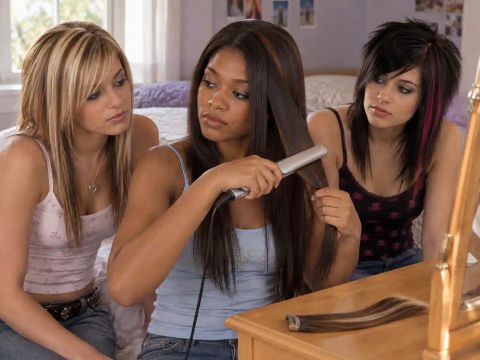
The 2000s are close enough to feel remembered rather than researched, which is a trap: our sense of “noughties hair” comes largely from celebrity photographs and later nostalgia. This page sets out what we can date and what we still have to check. Its evidence so far is thin on everyday wear, and we say so section by section.
Heat at home: straighteners and dryers
The Science Museum Group collected a pair of GHD hair straighteners dated to about 2000 and catalogued them as a domestic appliance.[1] Evidence status: Verified Evidence status: Interpretation The catalogue category matters: flat irons with heated plates had become something kept in a bedroom rather than only a salon, and the long, very straight, glossy finish associated with the decade depended on daily heat applied at home.
Evidence status: Research “Ionic” and ceramic dryers and straighteners were widely advertised with claims about shine and frizz. We have not yet found an independent, dated source for when they reached British shops or what the claims meant technically, and we do not repeat marketing claims as fact. Nor have we checked how widely straighteners were owned, and by whom; household survey or sales data is still to be found.
Evidence status: Interpretation Straightening was never only a fashion for straight or wavy hair. For many women with curly and Afro-textured hair, flat irons joined an older repertoire of pressing and chemical relaxing. Treating the flat iron as a single “trend” flattens those different histories; see Black hair and identity.
Chunky highlights, side fringes and scene cuts
Evidence status: Research Several looks are strongly associated with the decade in Britain: contrasting, “chunky” highlights early on; long side-swept fringes; flat-ironed lengths; deliberately messy buns; and, among teenagers in the second half of the decade, the layered, dyed-black “scene” and “emo” cuts with heavy fringes. These associations still need checking against dated evidence — magazines, salon price lists, school photographs and forum posts — rather than later listicles. We also want to record revivals of earlier styles, such as 1940s-inspired rolls and 1960s volume, with dates and places.
Extensions and the global hair trade
Evidence status: Research Clip-in extensions and bonded or sewn-in extensions became more visible in high-street salons and shops. When clip-ins became cheap and widespread in Britain is still to be established from trade and retail evidence.
The hair itself often came from far away. Summarising Emma Tarlo’s research, Goldsmiths, University of London reported in 2016 that hair is harvested most from poor women in South and Southeast Asia, or through Hindu temples in India and Buddhist initiatives in Myanmar, and that China is the world’s largest supplier of wigs and extensions.[6] Evidence status: Verified A 2021 Leverhulme Trust feature on Tarlo’s research reports that temple hair from southern India is valued in the trade for its naturalness, length and texture, but that temple hair is only about a fifth of the raw hair India exports: most is salvaged combings, much of it untangled in Myanmar, and most human-hair products are made in China.[7] Evidence status: Verified These accounts describe the trade in the 2010s; how far they hold for the 2000s still needs checking in Tarlo’s book.
Evidence status: Interpretation Extensions connect a teenager’s clip-ins in an English town with women’s labour and religious practice in Asia. We will write about the religious offering of hair only with faith-literate advisers. See also wigs.
Smoothing treatments
Salon “keratin” or smoothing treatments promised to reduce frizz for weeks. The US Food and Drug Administration explains that the solution is usually sealed in with a flat iron, and that when it is heated, formaldehyde is released into the air as a gas; labels may name it as formaldehyde, formalin or methylene glycol.[4] Evidence status: Verified
Concern came to a head just after the decade ended. The US Occupational Safety and Health Administration’s timeline records that in 2010 stylists in Oregon reported nosebleeds and breathing problems, that products labelled formaldehyde-free were found to contain it, and that Ireland began recalling some products in October 2010.[5] Evidence status: Verified Evidence status: Interpretation The people most exposed were salon workers, who breathed the fumes day after day — a reminder that hair history is also a history of work. Evidence status: Research Action by British regulators still needs checking. We describe these treatments as history, not as instructions.
Makeover television and the first online communities
Television made the makeover a genre. Channel 4’s 10 Years Younger began on 28 April 2004; volunteers faced a public “age survey” before a makeover.[2] Evidence status: Verified Episode listings name hairdressers alongside cosmetic surgeons and dentists on its makeover teams, though we have not yet confirmed that from Channel 4’s own records. Evidence status: Interpretation The format treated hair as one part of a whole-body project of looking younger, aimed chiefly at women in midlife.
Online, hair advice moved into forums, blogs and early video. The V&A, which has collected an early YouTube page, records that YouTube was registered as a company on 14 February 2005 and uploaded its first video on 23 April 2005.[3] Evidence status: Verified Evidence status: Research British hair forums and blogs of the decade — including those where women shared knowledge about Afro-textured and curly hair — still need to be found and captured through web archives. The next decade’s tutorial culture is covered in the 2010s.
Age: pre-teens, teenagers and older women
Evidence status: Research The decade saw products, salons and magazines aimed at girls under 13 — hair accessories, glitter sprays, “tween” styling kits, and straighteners owned by pre-teens. We have not yet gathered dated evidence of what was sold or how girls used it, and we want girls’ own accounts, not only adult commentary.
Evidence status: Interpretation Anxiety about girls “growing up too fast” recurs in every period on this site. Before repeating it, we want to know what girls actually did: for many, a straightener or a clip-in was a way to join friends, practise a skill, or experiment safely with a look that washed or unclipped out. Parents, schools and money set the limits, as they always had. See Age and hair and Hair and school.
Evidence status: Research Older women appear in the record chiefly as makeover subjects. How women over 60 in Britain and Ireland actually wore and cared for their hair in the 2000s is a gap we have not yet filled.
Styles, techniques and people from this period
-
1930–2014
J. D. ’Okhai Ojeikere
Nigerian photographer whose Hairstyles series, begun in 1968, is one of the richest visual records of women’s hair in any country — made in the years after independence from British rule, and now held in London as well as Paris and New York.
-
Essay
Black British hair
From suitcases packed with hot combs to Tottenham hair businesses, Brixton salons, Alexandra Palace hair shows and the Halo Code — a history of hair in Black British communities since 1945, told as skill, trade, family time and pleasure as well as struggle.
-
Essay
How trends travel
From engraved coiffure plates to TikTok, each new medium changed how fast a hairstyle could be seen. This essay follows the channels (prints, photographs, film, fan magazines, trade journals, television and platforms) and asks what evidence could ever show that a famous head caused many others to follow.
-
Essay
Heat, electricity and chemistry
Taps, shampoo, tongs, dryers, perm machines, relaxers, synthetic dyes, plastics and fibres all changed what could be done with hair. This essay asks what each one cost in time, labour and money — and who could afford it — mainly in Britain, with American comparison.
-
Style · Dressed style
The bun and chignon
Hair gathered, coiled and pinned — a form that has meant imperial elegance, respectable adulthood, workplace safety and, lately, deliberate messiness.
-
Style · Addition or covering
Wigs and hairpieces
Added hair is part of hair culture, not "fake hair" — from ancient plaited wigs to Victorian switches, 1960s fashion wigs, extensions and wigs worn through illness.
-
Technique · Temporary setting
Pressing and straightening
Straightening curly and coily hair with a heated comb, and later with chemical relaxers and smoothing treatments — skilled work with a long, contested history.
Sources
- Science Museum Group, “GHD hair straighteners (Y2007.94)”, c. 2000. Accessed 25 September 2026.
- Channel 4, “10 Years Younger”, Series 1 first broadcast 28 April 2004. Accessed 25 September 2026. What it shows: Channel 4's programme page; series 1 ran from 28 April 2004, volunteers faced a public "age survey" before a makeover. (The page no longer names the makeover team; episode listings name hairdressers such as Nicky Clarke.)
- Victoria and Albert Museum, “Acquiring an early YouTube watch page and its first-ever video”, V&A, last updated 19 February 2026. Accessed 25 September 2026. What it shows: YouTube was registered as a company on 14 February 2005, its first video was uploaded on 23 April 2005 and it launched its first website in May 2005; the V&A collected a watch page dated 8 December 2006.
- US Food and Drug Administration, “Hair Smoothing Products That Release Formaldehyde When Heated”, content current as of 15 October 2024. Accessed 12 November 2026. What it shows: “When the solution is heated, the formaldehyde in the products is released into the air as a gas”, which can seriously irritate the eyes, nose and lungs. Replaces the FDA’s 2021 consumer update on the same subject. (A proposed FDA ban on formaldehyde in straightening products had not been published when we checked in November 2026.)
- US Occupational Safety and Health Administration, “Hair Smoothing Products That Could Release Formaldehyde - Time line”, OSHA. Accessed 25 September 2026. What it shows: Month-by-month timeline of 2010–11 investigations into keratin-based smoothing products, including tests of products labelled formaldehyde-free, stylists' reported nosebleeds and breathing problems, and recalls in Ireland in October 2010.
- Goldsmiths, University of London, New book untangles global hair trade, 11 October 2016. Accessed 25 September 2026. What it shows: University news release on Emma Tarlo's research; hair is harvested most from poor women in South and Southeast Asia and through Hindu temples in India and Buddhist initiatives in Myanmar, and China is the largest supplier of wigs and extensions.
- Carolyn Allen (on Emma Tarlo’s research), The secret lives of human hair, The Leverhulme Trust, 30 July 2021. Accessed 25 September 2026. What it shows: Tarlo's own summary of her research; temple hair from southern India is valued for naturalness, length and texture, but most traded hair is salvaged combings, untangled in Myanmar and manufactured largely in China.
Further reading
- Emma Tarlo, Entanglement: The Secret Lives of Hair, Oneworld, 2016. details to check An anthropology of the global trade in human hair, wigs and extensions, and of hair loss.
- Ayana D. Byrd and Lori L. Tharps, Hair Story: Untangling the Roots of Black Hair in America, St. Martin’s Press, 2001. details to check
- Emma Dabiri, Don’t Touch My Hair, Allen Lane, 2019. details to check An Irish-Nigerian writer on Black hair, history and culture.