
Technique
Pressing and straightening
Straightening curly and coily hair with a heated comb, and later with chemical relaxers and smoothing treatments — skilled work with a long, contested history.
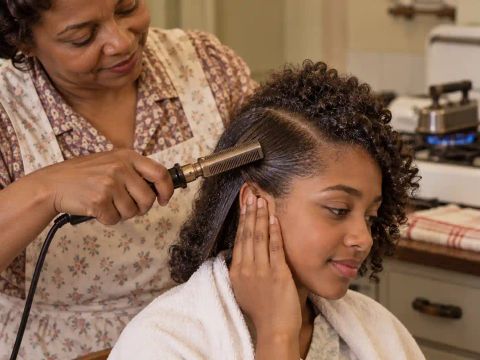
Pressing temporarily straightens curly or coily hair with heat: a metal pressing combA metal comb heated and drawn through hair to straighten it temporarily. Madam C. J. Walker did not invent it, despite a recurring claim. is heated and drawn through small sections. It lasts until the hair meets water or humidity. RelaxersA chemical treatment that straightens curly or coily hair by altering its internal bonds. Explanations of chemistry on this site are general history, not advice., by contrast, straighten chemically and last until the hair grows out.
The pressing comb
Pressing was often done at home as well as in salons: the Smithsonian notes combs heated on the kitchen stove, in a salon heater, or later plugged into the wall.[1] Evidence status: Verified Evidence status: Interpretation That makes it part of family history as much as beauty history — a routine of heat, time, care and conversation that advertising alone cannot capture.
Evidence status: Interpretation It was also a routine with real risk. A comb that was too hot, or that slipped, could scorch hair or burn the ears, forehead and neck; many people remember holding an ear down out of the comb’s way. How often this happened, and how it was taught and prevented, is not yet documented here.
Why straighten?
Evidence status: Interpretation There is no single answer. Straightening could be about fashion, convenience, versatility, professional expectations, respectability or the pressure of racialised beauty standards — often several at once. We do not reduce it to self-hatred, and we do not pretend the pressure was absent. See Black hair and identity.
Relaxers and smoothing
Chemical relaxers changed straightening from a temporary to a longer-lasting process. The British Association of Dermatologists notes that the risk of hair loss from tight styles is increased when they are combined with chemical treatments such as relaxers.[2] Evidence status: Verified
Relaxers are strong chemicals, and their risks are not only long-term. The British Association of Dermatologists warns that a relaxer left on too long can burn the scalp, and that such burns can lead to permanent hair loss; on the skin, relaxers can cause contact dermatitis. It also notes reports linking relaxer use with a higher risk of a scarring form of hair loss, central centrifugal cicatricial alopecia.[4] Evidence status: Verified
More recently, “smoothing” treatments for many hair textures have raised a different concern: the US Food and Drug Administration warns that when some smoothing solutions are heated, formaldehyde is released into the air as a gas.[3] Evidence status: Verified
Evidence status: Research When relaxers arrived in British shops and salons, and how Black British women and hairdressers adopted, adapted or rejected them, still needs checking against community archives.
Texture and scope
This page concerns curly and coily hair, where pressing has its deepest history. Straightening straight-to-wavy hair with irons and blow-dryers belongs to a related but separate story.
Tools and styles
-
Object · Prehistoric to present
The comb
The most ordinary hair tool, and one of the most revealing — from ancient carved combs to celluloid dressing-table sets, wide-toothed picks and heated pressing combs.
-
Object · c. 1575 BCE to present
Curling tongs and the Marcel iron
Heated metal pincers for curling and waving hair — a tool with a history of more than three thousand years, from Egyptian bronze to the salon Marcel iron.
Sources
- Moriah James, “Sizzle”, Smithsonian Institution, 10 January 2019. Accessed 25 September 2026. What it shows: On the pressing (hot) comb. Corrects the misconception that Madam C. J. Walker invented it; she and her “hair culturists” regularly used it, and her textbook taught a straightening process, though she said her products were for healthy hair. Also lists Poro’s “Marcel Waving Iron” and “Marcel Comb”, and combs heated on the kitchen stove.
- British Association of Dermatologists, “Traction alopecia”, produced February 2019. Accessed 25 September 2026. What it shows: Patient information leaflet. Names tight ponytails, buns, braids, weaves and extensions, clips and tight head scarves; risk rises when combined with chemical relaxers. The leaflet’s own review date (February 2022) has passed.
- US Food and Drug Administration, “Hair Smoothing Products That Release Formaldehyde When Heated”, content current as of 15 October 2024. Accessed 12 November 2026. What it shows: “When the solution is heated, the formaldehyde in the products is released into the air as a gas”, which can seriously irritate the eyes, nose and lungs. Replaces the FDA’s 2021 consumer update on the same subject. (A proposed FDA ban on formaldehyde in straightening products had not been published when we checked in November 2026.)
- British Association of Dermatologists, “Caring for Afro-textured hair”, produced July 2023. Accessed 12 November 2026. What it shows: Patient information leaflet. Says a relaxer should never be left on long enough to burn the scalp, that burns can lead to permanent hair loss, that relaxers on skin can cause contact dermatitis, and that there have been reports linking relaxer use with a higher risk of central centrifugal cicatricial alopecia (CCCA), a scarring hair loss. The leaflet’s own next review date (July 2026) has passed.
Further reading
- Ayana D. Byrd and Lori L. Tharps, Hair Story: Untangling the Roots of Black Hair in America, St. Martin’s Press, 2001. details to check
- Noliwe M. Rooks, Hair Raising: Beauty, Culture, and African American Women, Rutgers University Press, 1996. details to check
- Emma Dabiri, Don’t Touch My Hair, Allen Lane, 2019. details to check An Irish-Nigerian writer on Black hair, history and culture.