
1990–1999
Minimal and layered
Cropped and slicked, layered and blow-dried, braided and extended — a decade of session stylists, sitcom haircuts and hair shows, and of sharp arguments over who got credit for braids.
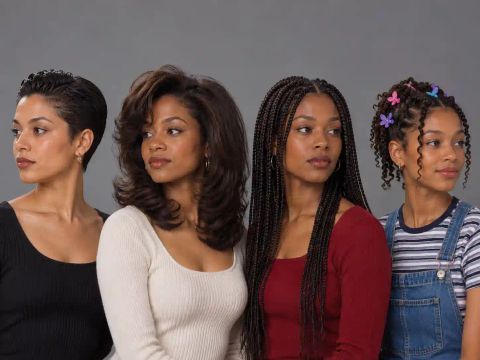
The 1990s are often remembered through a handful of famous heads. Behind them was a trade in which session stylists, television and magazines made cuts recognisable faster than before — and a hair economy, especially for Black British women, that had its own shows, salons and press. This page is written as history: the “trends” below are dated, not current.
Session stylists, supermodels and a princess
Fashion photography made hairstylists into names. Somerset House’s 2016–17 exhibition on Sam McKnight presented the session stylist’s role within fashion; McKnight created the short, slicked-back style worn by Diana, Princess of Wales, and worked with models including Kate Moss, Linda Evangelista, Christy Turlington and Naomi Campbell.[2] Evidence status: Verified
Evidence status: Interpretation A princess’s crop and a supermodel’s cover shoot made short, sleek hair highly visible for adult women. That is evidence of what was seen, not of how many women copied it. See the bob.
The “Rachel”: television and layered cutting
A reference entry credits the “Rachel” to Chris McMillan of Los Angeles, who cut it for Jennifer Aniston as Rachel on the US sitcom Friends: long layers falling just below the shoulder, given fullness with Velcro rollers. It reports that the style spread among women in the United States and Great Britain.[3] Evidence status: Verified Evidence status: Research The entry dates the cut to the show’s second season, but other accounts place its first appearance in a first-season episode, “The One With the Evil Orthodontist”, broadcast in the US in April 1995,[12] with Friends reaching Channel 4 later that month; we still need to confirm both dates from broadcasters’ records.
Evidence status: Interpretation Layered cuts relied on daily work at home — a hand-held dryer and a round brush — in a way the weekly roller set had not. The Science Museum Group’s dated dryers run up to 1999.[10] It holds a GHD straightener dated to about 2000 — though ghd itself was founded in 2001, so that date can only be approximate.[11][1] Evidence status: Verified Evidence status: Research How widely ceramic flat irons were used in Britain before that date, and at what price, still needs checking against catalogues and trade press.
Grunge, clips and ponytails
Evidence status: Research Grunge’s unwashed, grown-out look, butterfly clips, sleek high ponytails and updos with loose tendrils are all strongly associated with the decade, and with music television and teen magazines. We have not yet gathered dated British evidence — magazine issues, school photographs, shop catalogues — to show who wore them, where and at what ages. Until we do, we list them as associations, not documented trends.
The V&A itself treated street style as history in these years: its exhibition Streetstyle, From Sidewalk to Catwalk, 1940 to Tomorrow ran in 1994–95, and the photographer Normski recreated hip hop looks for it.[9] Evidence status: Verified
Braids, relaxers and a British hair economy
Black British women’s hair already had its own media before the decade began: the London Museum holds a 1986 issue of Black Beauty and Hair, a bi-monthly for “the beauty conscious black woman”, recommended by the Caribbean/Afro Society of Hairdressers UK.[6] Evidence status: Verified In 1994 the Afro Hair and Beauty Show arrived at Alexandra Palace in north London, where it was held for the next fifteen years.[7] Evidence status: Verified The photographer Eileen Perrier made portraits of people at the show from 1998 to 2003, showing a wide range of styles; she recalls that as a child her own hair was often cornrowed or wrapped in black cotton thread.[8] Evidence status: Verified
Box braidsBraids made from square sections of hair, often lengthened with added hair. In knotless braids, extensions are fed in gradually rather than knotted at the root., braided extensions and sewn or bonded weaves sat beside relaxedA chemical treatment that straightens curly or coily hair by altering its internal bonds. Explanations of chemistry on this site are general history, not advice. and pressed styles, often worn by the same woman at different times. Writing about the United States, JSTOR Daily says that the 1980s and 1990s brought more pressed and chemically straightened hair among Black women, encouraged by television and magazine advertising.[5] Evidence status: Verified Evidence status: Research British salon prices, the time braiding took, and who did it — salons, home braiders, family members — still need checking. See Black hair and identity and pressing.
Evidence status: Research Highlights and salon colour were widespread among white and lighter-haired women in the decade, but we have not yet found dated British price lists or surveys to show how widespread.
Who got the credit
In 1991 the law professor Paulette Caldwell published a critique of Rogers v. American Airlines (1981), in which a US court upheld an airline’s ban on a Black employee’s all-braided hairstyle. The court pointed to the airline’s assertion that she had adopted it shortly after it had been “popularized” by Bo Derek, a white actress, in the film “10”. Caldwell answered that a braided style had been “popularized” on national television “by a black actress, Cicely Tyson, nearly a decade before”.[4] Evidence status: Verified JSTOR Daily also reports that a Hyatt Regency hotel used that ruling to make an employee, Cheryl Tatum, resign, less than a decade later, after she refused to take out her cornrows.[5] Evidence status: Verified
Evidence status: Interpretation Caldwell’s article, published at the start of the decade, set out the pattern this page is concerned with: a style from Black communities could be credited to a white celebrity while Black women wearing it were penalised at work. Evidence status: Research These are American cases. We have not yet found dated British workplace or school disputes over braids in the 1990s, and we will not assume the American pattern transferred unchanged. See braids and hair and school.
Age
Evidence status: Research Butterfly clips, scrunchies and braids are often remembered as school-age and teenage styles, and teen magazines addressed girls directly about hair. Which magazines, which advice and which rules schools actually enforced still need checking against dated issues and school records. Midlife women appear here mainly through celebrity images; their everyday salon routines — cuts, colour to cover grey, relaxer touch-ups — are a gap we have not yet filled.
Styles, techniques and people from this period
-
c. 1920–2003
Christina M. Jenkins
Ohio cosmetologist who patented a method of weaving added hair onto a client's own hair in 1952, called it the Hair-Weev, and spent four decades teaching it — a founder of modern sewn-in weaving, not the inventor of added hair.
-
Essay
Black British hair
From suitcases packed with hot combs to Tottenham hair businesses, Brixton salons, Alexandra Palace hair shows and the Halo Code — a history of hair in Black British communities since 1945, told as skill, trade, family time and pleasure as well as struggle.
-
Essay
How trends travel
From engraved coiffure plates to TikTok, each new medium changed how fast a hairstyle could be seen. This essay follows the channels (prints, photographs, film, fan magazines, trade journals, television and platforms) and asks what evidence could ever show that a famous head caused many others to follow.
-
Essay
Heat, electricity and chemistry
Taps, shampoo, tongs, dryers, perm machines, relaxers, synthetic dyes, plastics and fibres all changed what could be done with hair. This essay asks what each one cost in time, labour and money — and who could afford it — mainly in Britain, with American comparison.
-
Style · Cut
The bob
A family of short cuts whose meanings kept changing — from a 1920s statement to 1960s geometry to a style so familiar it now barely registers.
-
Style · Braided, twisted or locked
Braids and plaits
One of the oldest ways of dressing hair — and not one style but many, from a school plait tied with a ribbon to cornrows, box braids and ancient braided wigs.
-
Style · Dressed style
The ponytail
Hair gathered and tied at the back of the head — practical for school and sport, a symbol of 1950s teenagers, and a style whose tightness matters.
-
Technique · Temporary setting
Pressing and straightening
Straightening curly and coily hair with a heated comb, and later with chemical relaxers and smoothing treatments — skilled work with a long, contested history.
Sources
- The Yorkshire Post, “ghd: How firm is strengthening its Yorkshire roots to give women worldwide a ‘good hair day’”, The Yorkshire Post. Accessed 12 November 2026. details to check What it shows: Business feature. Says ghd (Good Hair Day) was founded in Yorkshire in 2001 by the former hairdresser Robert Powls with his business partners Gary Douglas and Martin Penny. Read through search-result text; the site blocks automated access.
- Somerset House, “Hair by Sam McKnight”, exhibition, 2 November 2016 – 12 March 2017. Accessed 25 September 2026. What it shows: Exhibition on the session hairstylist Sam McKnight, who created Diana, Princess of Wales’s short, slicked-back style and worked with Kate Moss, Linda Evangelista, Christy Turlington and Naomi Campbell.
- Fashion, Costume, and Culture (via Encyclopedia.com), “Rachel Haircut”, Fashion, Costume, and Culture: Clothing, Headwear, Body Decorations, and Footwear through the Ages. Accessed 25 September 2026. What it shows: Reference entry crediting the cut to Chris McMillan of Los Angeles for Jennifer Aniston on Friends; long layers just below the shoulder, Velcro rollers for fullness; spread in the United States and Great Britain. Print edition details still to check.
- Paulette M. Caldwell, “A Hair Piece: Perspectives on the Intersection of Race and Gender”, Duke Law Journal, vol. 40, no. 2, pp. 365–396, 1991. Accessed 25 September 2026. What it shows: Critiques Rogers v. American Airlines (1981), in which the court pointed to the airline’s assertion that the plaintiff adopted braids after they were “popularized” by Bo Derek in the film “10”; Caldwell notes Cicely Tyson wore braids on national television nearly a decade earlier.
- Chanté Griffin, “How Natural Black Hair at Work Became a Civil Rights Issue”, JSTOR Daily, 3 July 2019. Accessed 25 September 2026. What it shows: Describes the 1981 American Airlines braids case (without naming it) and the Hyatt Regency’s treatment of Cheryl Tatum’s cornrows (less than a decade later); says US hair-care advertising in the 1980s and 1990s encouraged Black women to alter their hair’s texture.
- London Museum, “Black Beauty and Hair Magazine (2007.1/166)”, May–June 1986. Accessed 25 September 2026. What it shows: A bi-monthly British magazine for “the beauty conscious black woman”, recommended by the Caribbean/Afro Society of Hairdressers UK.
- Alexandra Palace, “A Look Back at Alexandra Palace (timeline)”. Accessed 25 September 2026. What it shows: Under 1994, records that the Afro Hair and Beauty Show arrived at Alexandra Palace and ran there for the next fifteen years.
- Autograph, “Eileen Perrier Afro Hair and Beauty Show, 1998-2003”. Accessed 25 September 2026. What it shows: Perrier’s portraits of attendees at the Afro Hair and Beauty Show, Alexandra Palace, 1998–2003, on improvised backdrops; quotes Perrier on her own childhood cornrows and thread-wrapped hair.
- Victoria and Albert Museum, “Staying Power: Photographs of Black British Experience”. Accessed 25 September 2026. What it shows: V&A and Black Cultural Archives project on Black British experience 1950s–1990s; records the V&A exhibition Streetstyle, From Sidewalk to Catwalk, 1940 to Tomorrow (1994–95), for which the photographer Normski recreated hip hop looks. Also gives a biography of J. D. ’Okhai Ojeikere (Ministry of Information darkroom 1954–61; West African Publicity 1963–75; Hairstyles from 1968; “more than a thousand hairstyles”), credits images “© The Estate of J. D. ’Okhai Ojeikere”, and records the partnership’s 118 works by 17 artists.
- Science Museum Group, “Hair dryer (object type listing)”. Accessed 25 September 2026. What it shows: Dated dryers, mostly British, from stoneware (1880–1900) to electric hand, hood and salon models (1920–1999).
- Science Museum Group, “GHD hair straighteners (Y2007.94)”, c. 2000. Accessed 25 September 2026.
- Jay Serafino, “The One Where Jennifer Aniston’s “Rachel” Haircut on ‘Friends’ Became a Phenomenon”, Mental Floss, updated 24 April 2023. Accessed 12 November 2026. What it shows: Says the Rachel was first worn “in the April 1995 episode ‘The One With the Evil Orthodontist.’”
Further reading
- Ayana D. Byrd and Lori L. Tharps, Hair Story: Untangling the Roots of Black Hair in America, St. Martin’s Press, 2001. details to check
- Emma Dabiri, Don’t Touch My Hair, Allen Lane, 2019. details to check An Irish-Nigerian writer on Black hair, history and culture.
- Emma Tarlo, Entanglement: The Secret Lives of Hair, Oneworld, 2016. details to check An anthropology of the global trade in human hair, wigs and extensions, and of hair loss.
- Caroline Cox, Good Hair Days: A History of British Hairstyling, Quartet Books, 1999. details to check A general history of British hairdressing and styles.