Style
The ponytail
Hair gathered and tied at the back of the head — practical for school and sport, a symbol of 1950s teenagers, and a style whose tightness matters.
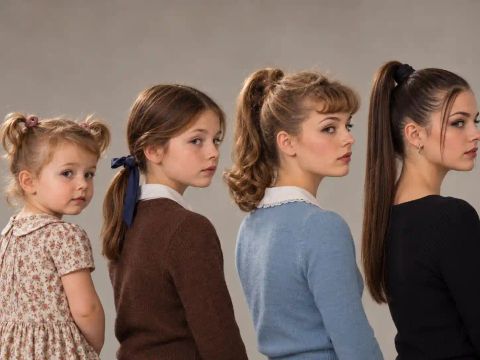
A ponytail is hair gathered at the back of the head and tied, leaving the length to hang free. Tying hair back is as old as long hair; what changes over time is where the tie sits, how smooth the hair is, and what the style is taken to mean.
Form and construction
The hair is brushed or combed back, gathered and secured — historically with a ribbon or string, later with elastic bands, clips and covered bobbles. Height matters: a low ponytail at the nape reads very differently from a high one at the crown.
Age and life stage
- Early childhood and school age: ponytails and bunches are often done for children by adults, and are a common response to rules that long hair must be tied back. Evidence status: Research Historical school rules on tying hair back still need to be checked in school records; see Hair and school.
- Teenagers: Evidence status: Research the ponytail is strongly associated with 1950s teenagers in film and advertising. How widely it was worn by British girls, and at what ages, still needs checking against photographs.
- Young adults: from sport to the sleek, high ponytail of the 1990s, a style that could signal both practicality and polish.
Tension and health
The British Association of Dermatologists names tight ponytails among the hairstyles often associated with traction alopecia, causing hair loss at the front and side margins of the scalp.[1] Evidence status: Verified
Meanings
Evidence status: Interpretation Few styles are read as more “neutral” than a ponytail — which is exactly why it is worth noticing whose ponytails are called neat and whose are not. School policies that treat a straight-haired ponytail as tidy and a voluminous textured style as unacceptable are the subject of current guidance on discrimination in Britain.[2]
How was it made?
-
Object · Prehistoric to present
The comb
The most ordinary hair tool, and one of the most revealing — from ancient carved combs to celluloid dressing-table sets, wide-toothed picks and heated pressing combs.
Sources
- British Association of Dermatologists, “Traction alopecia”, produced February 2019. Accessed 25 September 2026. What it shows: Patient information leaflet. Names tight ponytails, buns, braids, weaves and extensions, clips and tight head scarves; risk rises when combined with chemical relaxers. The leaflet’s own review date (February 2022) has passed.
- Equality and Human Rights Commission, “Preventing hair discrimination in schools”, published 27 October 2022. Accessed 25 September 2026. What it shows: Current guidance for schools in Britain. A policy banning hairstyles associated with particular racial or religious groups, without exceptions, is likely to be unlawful indirect discrimination; names Afro hairstyles, braids, locks, twists, cornrows, plaits, skin fades, head coverings and head wraps, and disability-related needs such as wigs during cancer treatment.
Further reading
- Caroline Cox, Good Hair Days: A History of British Hairstyling, Quartet Books, 1999. details to check A general history of British hairdressing and styles.
- Rose Weitz, Rapunzel’s Daughters: What Women’s Hair Tells Us About Women’s Lives, Farrar, Straus and Giroux, 2004. details to check