
Style
The beehive
A tall, rounded dome of backcombed hair — one of the few styles with a named, dated creator, and a lesson in how a magazine commission could become a decade’s silhouette.
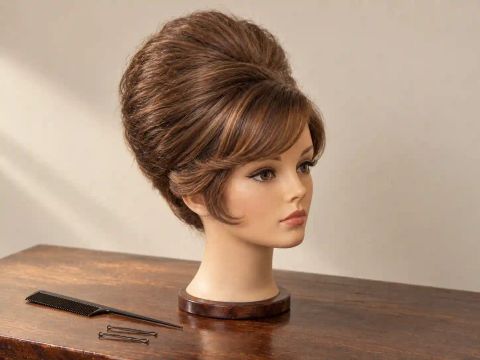
The beehive is a tall, rounded shape built from backcombed hair, smoothed over and pinned. Unlike most styles on this site, it has a named creator and a date.
A style with a known origin
The Chicago hairdresser Margaret Vinci Heldt is credited with creating the style for the February 1960 issue of Modern Beauty Shop magazine, which had asked for something new. According to her obituary, she took the shape from a favourite fez hat decorated with bumblebees.[1] Evidence status: Verified Heldt told the Toronto Star in 2011 that it made women feel “taller and more elegant, refined and glamorous”.[1]
Evidence status: Research Our evidence is an obituary drawing on Heldt’s own account and the Chicago History Museum. We still need to check the magazine issue itself for the style’s original name and description.
Form and construction
The beehive depended on backcombingCombing hair from the ends towards the roots to tangle it into a supporting cushion. The basis of 1960s bouffants and beehives. to create a firm cushion, smoothed over with a brush and held with pins and lacquer — usually on top of a roller set. Hairpieces could add height.
Maintenance
Evidence status: Research Beehives are often said to have been kept for a week or more between salon visits — wrapped at night and re-teased in the morning. This is plausible given the effort involved, but still needs checking against better evidence than jokes and anecdotes.
How far did it spread?
Evidence status: Interpretation The beehive shows how trends travelled in the early 1960s: from a trade magazine commission to salons, then to music and film, then to teenagers. In Britain it sat alongside the geometric cuts that would soon make it look old-fashioned. See the 1960s.
How was it made?
-
Technique · Temporary setting
Roller setting
Winding damp hair on rollers and drying it in place — the engine of the weekly "shampoo and set" and of mid-century volume.
-
Object · 1880s to present in British collections
The hair dryer
From a stoneware bottle of boiling water to the row of humming salon hoods — how drying, the slowest part of every set, was turned into a machine.
-
Object · Ancient to present
The hairpin
The small, easily lost tool that holds up almost every dressed style in history — from decorated Roman bronze to the mass-produced wire grip.
-
Object · Prehistoric to present
The comb
The most ordinary hair tool, and one of the most revealing — from ancient carved combs to celluloid dressing-table sets, wide-toothed picks and heated pressing combs.
Sources
- Maureen O’Donnell, “Margaret Vinci Heldt, creator of lofty beehive hairdo, dead at 98”, Chicago Sun-Times, 14 June 2016. Accessed 25 September 2026. What it shows: Obituary. Reports that Heldt created the style for the February 1960 issue of Modern Beauty Shop, inspired by a favourite fez. Evidence of her account and reputation; the magazine issue itself is the primary source to check.
Further reading
- Caroline Cox, Good Hair Days: A History of British Hairstyling, Quartet Books, 1999. details to check A general history of British hairdressing and styles.