1970–1979
Shags, feathers and afros
Long centre partings, feathered and shag cuts, Afros and braids, and punk’s bleach and spikes — a decade in which no single look ruled, and none carried a single meaning.
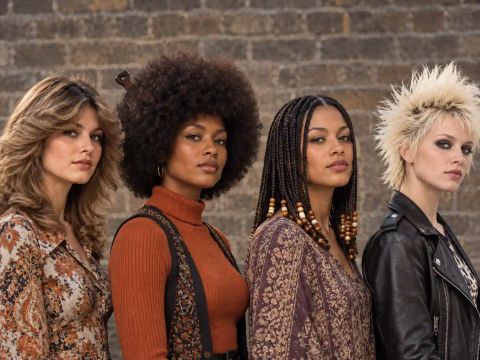
The 1970s had no single silhouette. Long, straight hair with a centre parting, layered and feathered cuts, shaggy crops, Afros, braids and the bleached, spiked hair of punk all existed at once — often in the same school or street.
Long, layered and blow-dried
Evidence status: Research Long centre-parted hair and layered “shag” and “feathered” cuts are strongly associated with the decade, and with film and television stars. How widely they were worn in Britain, and at what ages, still needs checking against school photographs, catalogues and magazines rather than celebrity images.
Evidence status: Interpretation Layered cuts depended on a different kind of daily labour from the weekly set: a hand-held dryer and a round brush at home, rather than rollers and a hood. The Science Museum Group’s collection includes electric dryers dated from the 1920s, Morphy Richards electric dryers from about 1960, and a Morphy Richards “Salonaire Supreme” dryer of about 1974 made for home use.[5] Evidence status: Verified Evidence status: Research When hand-held dryers became ordinary household objects still needs checking against sales and household surveys.
Afros, braids and the politics of “natural”
In the United States, the Afro had become a powerful expression of pride and politics through the “Black is Beautiful” movement.[1] Evidence status: Verified The University of Cambridge’s 2013 Origins of the Afro Comb exhibition traced the comb from pre-dynastic Egypt to the present, including “the politicising and popularisation of Afros and Dreadlocks”, and gathered hair stories from the public.[2] Evidence status: Verified
Evidence status: Research The history of Afros, braids and locs in 1970s Britain — in Caribbean and African communities, in reggae and sound-system culture, and in schools — is still to be researched. We will not assume American meanings transferred unchanged.
Evidence status: Interpretation No texture or style carried one political meaning. An Afro could be a statement, a fashion, a family habit or simply the easiest way to wear one’s hair.
Punk
Punk emerged in London in the mid-1970s, around shops, clubs and bands. The boutique at 430 King’s Road — Sex from 1974, Seditionaries from 1976 — was one centre. Its staff included Jordan (Pamela Rooke), photographed outside Sex with a beehive hairstyle.[3] Evidence status: Verified
Evidence status: Interpretation Jordan’s beehive is a reminder that punk reworked earlier styles as much as it invented new ones: a 1960s shape, bleached and exaggerated, became a provocation.
Punk hair could meet resistance at work, or not. A 1978 photograph by Henry Grant in the London Museum shows a young man with a mohican who worked as a car mechanic and, the museum notes, could wear it “without objection from his employers”.[4] Evidence status: Verified We include this image of a man for comparison. Evidence status: Research We still need to find dated photographs and testimony of young women punks at school and at work.
Age
Evidence status: Research Girls’ styles in the 1970s increasingly echoed popular media, but parents and school rules still controlled access to cutting, colour and chemicals. How that negotiation worked is not yet documented here.
Styles, techniques and people from this period
-
c. 1920–2003
Christina M. Jenkins
Ohio cosmetologist who patented a method of weaving added hair onto a client's own hair in 1952, called it the Hair-Weev, and spent four decades teaching it — a founder of modern sewn-in weaving, not the inventor of added hair.
-
1930–2014
J. D. ’Okhai Ojeikere
Nigerian photographer whose Hairstyles series, begun in 1968, is one of the richest visual records of women’s hair in any country — made in the years after independence from British rule, and now held in London as well as Paris and New York.
-
1938–2023
Kwame Brathwaite
Harlem photographer whose pictures of the Grandassa Models and the “Naturally” fashion shows made natural hair a visible ideal of beauty in the early 1960s, and whose images reached Black publications in Britain at the time.
-
1912?–2008
Rose Meta Morgan
Harlem beautician and entrepreneur whose Rose Meta House of Beauty was described as the largest Black beauty salon in the world, and who helped found a Black-owned bank in Harlem.
-
1928–2012
Vidal Sassoon
London hairdresser whose precision, geometric cutting made the cut itself the style in the 1960s — and, for some clients, replaced the weekly shampoo and set with a cut every few weeks.
-
Essay
Black British hair
From suitcases packed with hot combs to Tottenham hair businesses, Brixton salons, Alexandra Palace hair shows and the Halo Code — a history of hair in Black British communities since 1945, told as skill, trade, family time and pleasure as well as struggle.
-
Essay
From kitchen to salon
Most hair work has always been done unpaid, at home, by mothers, sisters, friends and women themselves. This essay follows that labour into the paid salon — a trade, a workplace, a women’s business and a meeting place — mainly in Britain and Ireland, with American and diasporic comparison.
-
Style · Dressed style
The Afro
Coily hair worn in its own texture and shaped into a rounded form — a powerful image of pride and politics, and also a style people wore for many other reasons.
-
Style · Braided, twisted or locked
Locs
Rope-like strands formed as hair is allowed or encouraged to mat — worn across many cultures and faiths, and still penalised by some school and workplace rules.
Sources
- Smithsonian National Museum of African American History and Culture, “Black is Beautiful: The Emergence of Black Culture and Identity in the 60s and 70s”, Smithsonian Institution. Accessed 25 September 2026. What it shows: The movement “affirmed natural hairstyles like the ‘Afro’” and inspired cultural pride; using an Afro pick customised with a black fist was a way to assert allegiance to the Black Power movement.
- University of Cambridge, “Origins of the Afro Comb: 6,000 years of culture, politics and identity”, 2 July 2013. Accessed 25 September 2026. What it shows: On the Fitzwilliam Museum and Museum of Archaeology and Anthropology exhibition (curated by Sally-Ann Ashton), tracing the comb from pre-dynastic Egypt to today and "the politicising and popularisation of Afros and Dreadlocks", with community hair stories.
- London Museum, “Vivienne Westwood & Malcolm McLaren: King’s Road royalty”. Accessed 25 September 2026. What it shows: The shop at 430 King’s Road — Let It Rock (1971), Sex (1974), Seditionaries (1976), Worlds End (1980) — and its staff, including Jordan (Pamela Rooke), shown with a beehive hairstyle outside Sex.
- Henry Grant (photographer); London Museum, “Punk (HG2806/76)”, photograph, 1978. Accessed 25 September 2026. What it shows: A young man with a mohican; the record notes he worked as a car mechanic and could wear the style "without objection from his employers". Included here for comparison.
- Science Museum Group, “Hair dryer (object type listing)”. Accessed 25 September 2026. What it shows: Dated dryers, mostly British, from stoneware (1880–1900) to electric hand, hood and salon models (1920–1999).
Further reading
- Caroline Cox, Good Hair Days: A History of British Hairstyling, Quartet Books, 1999. details to check A general history of British hairdressing and styles.
- Ayana D. Byrd and Lori L. Tharps, Hair Story: Untangling the Roots of Black Hair in America, St. Martin’s Press, 2001. details to check
- Emma Dabiri, Don’t Touch My Hair, Allen Lane, 2019. details to check An Irish-Nigerian writer on Black hair, history and culture.