1919–1929
The bob decade
Shingles, Eton crops and waved bobs; the power of cinema and print; finger waves and the heated permanent-wave machine — and far more variety than the “flapper” image suggests.
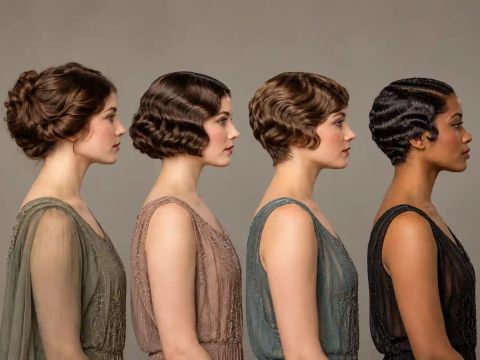
The 1920s are remembered as the decade women cut their hair. That is broadly true of fashionable women in London, and probably in Britain more widely, by the middle of the decade, but it hides a slower, more varied story.
Short hair, gradually
The London Museum notes that in the early 1920s women often kept their hair long but put it up at the back and teased curls out at the front to look bobbed; short hair became ubiquitous only in the mid-1920s.[1] Evidence status: Verified Cutting was a bigger decision than dressing: once cut, hair took years to grow back. (See the bob.)
The same article suggests that “flapper” itself may come from teenage girls whose long pigtails, tied with large bows, flapped as they moved — before adulthood required them to put their hair up. Evidence status: Research That etymology is offered as one possibility among several — other suggested origins include earlier slang senses of the word — and still needs checking against dated dictionary evidence.
The family of short cuts widened through the decade: the waved bob, the shingleA bob cut very short and tapered at the nape so that the back lies close to the head, often with waves at the sides. tapered at the nape, and the very short Eton cropA very short, close cut of the mid-to-late 1920s, named after the boys’ school. Among the shortest fashionable women’s cuts of the decade..
Cinema and print
Film stars made particular silhouettes instantly recognisable. The BFI traces the long afterlife of Louise Brooks’s sharply cut “Lulu bob”.[2] Evidence status: Interpretation Film accelerated recognition of specific shapes, but a star wearing a style is not proof that she started it or that audiences copied her. Newspapers and magazines — for the United States, the Library of Congress guide to “flappers” is a good entry point[3] — carried the arguments as well as the images.
Technique
Short hair needed regular cutting and, often, waving. Finger wavesA set in which wet hair is shaped with the fingers and a comb into ridges that run in an S-pattern across the head, then left to dry in place. and pin curlsA small curl wound flat against the head and held with a pin or clip while it sets. set the hair close to the head. For longer-lasting curl there was the machine permanent waveA process that changes the shape of the hair until it grows out, by chemically breaking and re-forming bonds in the hair. Early machine methods used heat as well as chemicals; “cold waves” did not.: a 1926 Library of Congress photograph shows Norma Smallwood, that year’s Miss America, seated with her hair attached to electric permanent-wave equipment.[4] Evidence status: Verified Evidence status: Interpretation A beauty queen was newsworthy publicity for a machine that most women would have met, if at all, in a salon.
Age
Evidence status: Interpretation Young women carried the strongest associations with rebellion in 1920s commentary, but the simplified silhouette spread well beyond the “flapper”. Girls had worn short, fringed cuts before.
Evidence status: Research How far, and how fast, midlife and older women in Britain took up short hair — and how commentators treated them — is not yet documented here; newspapers will be needed to check.
Beyond the fashionable image
Evidence status: Research We do not yet have evidence to describe how women with curly and coily hair in 1920s Britain wore the new short styles, or how working-class women paid for regular cuts and waves. These are gaps in our coverage that we are working to fill, not a statement that such women were absent.
Styles, techniques and people from this period
-
Object · c. 1575 BCE to present
Curling tongs and the Marcel iron
Heated metal pincers for curling and waving hair — a tool with a history of more than three thousand years, from Egyptian bronze to the salon Marcel iron.
-
Object · 1880s to present in British collections
The hair dryer
From a stoneware bottle of boiling water to the row of humming salon hoods — how drying, the slowest part of every set, was turned into a machine.
-
Object · 1920s onwards; cold-wave kits from the 1940s
The home permanent kit
A box of lotions, rods and papers that brought the permanent wave out of the salon and into the kitchen — and, in some kits, onto children’s heads.
-
1884–1976
Antoine de Paris
Antoni Cierplikowski, a Polish-born hairdresser who became “Antoine” of Paris — a celebrity salon owner long credited with the first fashionable ladies’ bob, a claim still without contemporary proof.
-
1869 or 1877 – 1957
Annie Turnbo Malone
Founder of the Poro hair-care company and its training network — a pioneer of Black women’s enterprise often overshadowed in popular memory.
-
1872–1951
Karl Nessler
The Black Forest-born hairdresser who, trading in London as “Charles Nestlé”, patented a heated permanent-waving process in 1909 — then rebuilt his business in New York after wartime internment.
-
1852–1936
Marcel Grateau
The Paris hairdresser whose name became the Marcel wave — a heated-iron wave worn for half a century. The technique’s fame is well documented; much of his life, and the patents often credited to him, are not.
-
1896–1994
Marjorie Stewart Joyner
Beautician, teacher and Walker company executive who patented a permanent-waving machine in 1928 and spent half a century training hairdressers — and organising them.
-
Essay
Age and hair
Who decides how a girl’s hair is worn, when that power passes to her, and what happens to it again in old age — a history told across a lifetime rather than a decade.
-
Essay
From kitchen to salon
Most hair work has always been done unpaid, at home, by mothers, sisters, friends and women themselves. This essay follows that labour into the paid salon — a trade, a workplace, a women’s business and a meeting place — mainly in Britain and Ireland, with American and diasporic comparison.
-
Essay
How trends travel
From engraved coiffure plates to TikTok, each new medium changed how fast a hairstyle could be seen. This essay follows the channels (prints, photographs, film, fan magazines, trade journals, television and platforms) and asks what evidence could ever show that a famous head caused many others to follow.
-
Essay
Heat, electricity and chemistry
Taps, shampoo, tongs, dryers, perm machines, relaxers, synthetic dyes, plastics and fibres all changed what could be done with hair. This essay asks what each one cost in time, labour and money — and who could afford it — mainly in Britain, with American comparison.
-
Style · Cut
The bob
A family of short cuts whose meanings kept changing — from a 1920s statement to 1960s geometry to a style so familiar it now barely registers.
-
Technique · Temporary setting
Finger waving
Shaping wet hair with fingers and a comb into rippling S-shaped ridges — the signature set of the late 1920s and 1930s, and a test of skill.
-
Technique · Temporary setting
Marcel waving
A deep, regular wave made with heated irons — a salon skill that shaped late-Victorian, Edwardian and 1920s hair, and a staple of Black beauty culture.
-
Technique · Chemical texture change
Permanent waving
Changing the shape of hair until it grows out — from hours attached to a heated machine to a cold-wave kit on the kitchen table.
Sources
- Beatrice Behlen, “Women’s fashion in 1920s London: Going out!”, London Museum, 6 January 2022. Accessed 25 September 2026. What it shows: Early in the decade women kept long hair but put it up at the back and teased curls out at the front to look bobbed; only in the mid-1920s did short hair become ubiquitous, leading to the Eton crop.
- Pamela Hutchinson, “How the Lulu bob became cinema’s most imitated haircut”, BFI, 29 May 2018, updated 9 November 2020. Accessed 25 September 2026. What it shows: Brooks had her bob cut in 1924 at Saveli’s New York salon and kept it for Pandora’s Box (1929); traces later imitations. Repeats the claim that Antoine de Paris cut the first ladies’ bob in 1909.
- Library of Congress, “Flappers: topics in Chronicling America”. Accessed 19 September 2026. What it shows: Research guide to digitised American newspapers; a route to primary reporting on bobbed hair.
- Library of Congress, Prints and Photographs Division, ““Miss America receives a permanent wave””, photograph, 14 October 1926. Accessed 25 September 2026. What it shows: Photograph of Norma Smallwood, Miss America 1926, seated with her hair attached to electric permanent-wave equipment.
Further reading
- Caroline Cox, Good Hair Days: A History of British Hairstyling, Quartet Books, 1999. details to check A general history of British hairdressing and styles.
- Geraldine Biddle-Perry and Sarah Cheang (eds), Hair: Styling, Culture and Fashion, Berg, 2008. details to check Cross-cultural essays on hair in fashion, film, art, history and consumer culture.