1946–1959
The post-war set
Home perm kits, roller sets and hood dryers; the weekly salon visit; ponytails and the new teenage market; and the migration that reshaped British hair businesses.
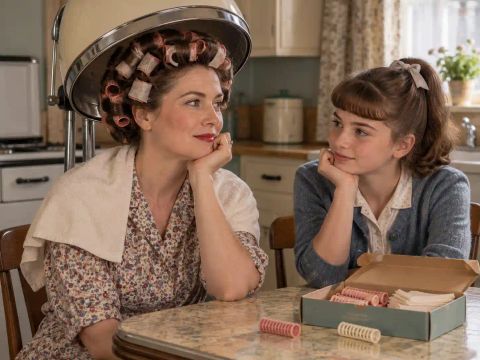
After the war, hair in Britain was shaped by chemistry, electricity and a new kind of consumer: the teenager. It was also shaped by migration, which brought new skills, needs and businesses to British cities.
Chemistry comes home
The Smithsonian’s National Museum of American History dates home permanent-wave kits to the late 1940s.[1] Evidence status: Verified Evidence status: Research Earlier home outfits existed (see the home permanent kit); when the first cold-wave kits went on sale is still being checked. Among the museum’s objects is an undated home permanent made for children.[2] See the home permanent kit and permanent waving.
Evidence status: Research These objects are American. When home kits reached British shops, and which brands British women used, still needs checking.
Electricity comes home
The Science Museum Group holds a 1958 Pifco hair dryer with its own stand and hood, catalogued as a domestic appliance.[3] Evidence status: Verified Evidence status: Interpretation It is, in effect, the salon hood made for the home. See the hair dryer.
The weekly set
Evidence status: Interpretation For many adult women the defining routine of the decade was the set: hair wound on rollers and dried, either at a weekly salon appointment or at home, then brushed and dressed to last until the next wash. It took time and money, and it shaped women’s weeks.
Teenagers
Evidence status: Research The 1950s saw “teenage” marketing grow, and the ponytail and short fringe became associated with young people in film and advertising. How far British girls actually wore these styles, and at what ages, still needs checking against school photographs and magazines.
Migration
Evidence status: Research Post-war migration from the Caribbean, South Asia and Africa brought people whose hair needed products, tools and skills that British shops and salons often did not provide. How they sourced them — through imports, home skills, and new businesses — is one of the most important stories in this period, and one we have not yet researched. We will do so through the Black Cultural Archives, community histories and oral testimony.
Girls and mothers
Evidence status: Interpretation The children’s home perm, though not yet dated, is a small object with a large implication: that a girl’s hair was a family project, and that adult fashions were adapted — chemically — for children.
Styles, techniques and people from this period
-
Object · 1880s to present in British collections
The hair dryer
From a stoneware bottle of boiling water to the row of humming salon hoods — how drying, the slowest part of every set, was turned into a machine.
-
Object · Ancient to present
The hairpin
The small, easily lost tool that holds up almost every dressed style in history — from decorated Roman bronze to the mass-produced wire grip.
-
Object · 1920s onwards; cold-wave kits from the 1940s
The home permanent kit
A box of lotions, rods and papers that brought the permanent wave out of the salon and into the kitchen — and, in some kits, onto children’s heads.
-
c. 1920–2003
Christina M. Jenkins
Ohio cosmetologist who patented a method of weaving added hair onto a client's own hair in 1952, called it the Hair-Weev, and spent four decades teaching it — a founder of modern sewn-in weaving, not the inventor of added hair.
-
1938–2023
Kwame Brathwaite
Harlem photographer whose pictures of the Grandassa Models and the “Naturally” fashion shows made natural hair a visible ideal of beauty in the early 1960s, and whose images reached Black publications in Britain at the time.
-
1896–1994
Marjorie Stewart Joyner
Beautician, teacher and Walker company executive who patented a permanent-waving machine in 1928 and spent half a century training hairdressers — and organising them.
-
1912?–2008
Rose Meta Morgan
Harlem beautician and entrepreneur whose Rose Meta House of Beauty was described as the largest Black beauty salon in the world, and who helped found a Black-owned bank in Harlem.
-
1928–2012
Vidal Sassoon
London hairdresser whose precision, geometric cutting made the cut itself the style in the 1960s — and, for some clients, replaced the weekly shampoo and set with a cut every few weeks.
-
Essay
Age and hair
Who decides how a girl’s hair is worn, when that power passes to her, and what happens to it again in old age — a history told across a lifetime rather than a decade.
-
Essay
Black British hair
From suitcases packed with hot combs to Tottenham hair businesses, Brixton salons, Alexandra Palace hair shows and the Halo Code — a history of hair in Black British communities since 1945, told as skill, trade, family time and pleasure as well as struggle.
-
Essay
From kitchen to salon
Most hair work has always been done unpaid, at home, by mothers, sisters, friends and women themselves. This essay follows that labour into the paid salon — a trade, a workplace, a women’s business and a meeting place — mainly in Britain and Ireland, with American and diasporic comparison.
-
Essay
How trends travel
From engraved coiffure plates to TikTok, each new medium changed how fast a hairstyle could be seen. This essay follows the channels (prints, photographs, film, fan magazines, trade journals, television and platforms) and asks what evidence could ever show that a famous head caused many others to follow.
-
Essay
Heat, electricity and chemistry
Taps, shampoo, tongs, dryers, perm machines, relaxers, synthetic dyes, plastics and fibres all changed what could be done with hair. This essay asks what each one cost in time, labour and money — and who could afford it — mainly in Britain, with American comparison.
-
Style · Dressed style
The ponytail
Hair gathered and tied at the back of the head — practical for school and sport, a symbol of 1950s teenagers, and a style whose tightness matters.
-
Technique · Chemical texture change
Permanent waving
Changing the shape of hair until it grows out — from hours attached to a heated machine to a cold-wave kit on the kitchen table.
-
Technique · Temporary setting
Roller setting
Winding damp hair on rollers and drying it in place — the engine of the weekly "shampoo and set" and of mid-century volume.
Sources
- Smithsonian National Museum of American History, “Hair Care”, Smithsonian Institution. Accessed 25 September 2026. What it shows: Object group of tools, products and packaging. States that home permanent-wave kits were introduced in the late 1940s.
- Smithsonian National Museum of American History, “Tonette Children’s Home Permanent”, Smithsonian Institution. Accessed 25 September 2026. What it shows: Collection object 1984.0351.320, made by the Toni Company (Reid Drugstore collection, gift of Blanche E. Reid); undated. Evidence that chemical waving was sold for use on children; not evidence of how often it was used.
- Science Museum Group, “Pifco hair dryer with stand and hood, 1958 (1995-316)”. Accessed 25 September 2026.
Further reading
- Caroline Cox, Good Hair Days: A History of British Hairstyling, Quartet Books, 1999. details to check A general history of British hairdressing and styles.
- Kathy Peiss, Hope in a Jar: The Making of America’s Beauty Culture, Metropolitan Books, 1998. details to check