
Source guide
Reading hair in family photographs
How to use hair to help date a family photograph — and why hair alone can mislead.
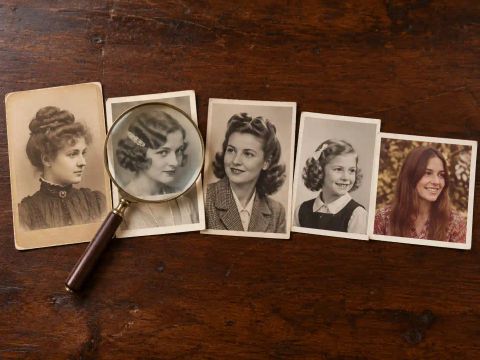
Hair is one of the most useful clues for dating an undated photograph, and one of the easiest to over-read. This guide sets out what to look at and what to be careful of. A full interactive guide, “Read a family photograph”, is planned.
What to look at
- Silhouette: is the hair close to the head or wide? Is the volume at the crown, the sides or the back?
- Parting: centre, side or none; straight or zigzag.
- Length: as far as it can be judged, which is often not far when hair is pinned up.
- Texture and set: natural texture, waves, curls, a set, pressing or chemical straightening.
- Accessories: ribbons, bows, combs, pins, nets, snoods, scarves, hats.
- The photograph itself: the format, mount and studio name are often better guides to date than the hair.
Cautions
- People keep the styles of their youth. Evidence status: Interpretation Older sitters often wear styles that were fashionable decades earlier, so dating a group photograph by its oldest member’s hair can mislead by a generation.
- Children’s hair was chosen by adults, often specially for the photograph. It tells you about the occasion as well as the period.
- Studio portraits were staged. They show a chosen presentation at one moment, not everyday hair.
- Hats hide hair. In many periods, outdoor photographs show more hat than hair.
- Retouching could smooth, darken or reshape hair, especially in commercial portraits.
- Fashion spread unevenly by place, class, age and community. A “1920s” bob might appear in a 1930s photograph from a village or a school.
Record what you cannot tell
For every photograph, write down what it cannot establish: whether the style was everyday or special, who made it, how long it took, and what the sitter thought of it. That list is as important as the date.
Next steps
Compare your photograph with our timeline and the style pages, and check your terms in Hair words. Found a dated example that would help others? Tell us.